Professional Presence Through Tailoring
A boardroom notices before it listens. The line of a shoulder, the clean fall of a trouser, the way a jacket closes without strain - these details speak in seconds. Professional presence through tailoring is not about dressing loudly. It is about creating a silhouette that appears composed, credible and entirely self-possessed.
For men whose work depends on trust, influence and judgement, clothing is never merely decorative. It frames how others receive you before a word is exchanged. A suit that fits with precision suggests command over detail. One that collapses at the chest, pulls across the waist or hangs without shape quietly undermines the same message. Tailoring, at its highest level, corrects that imbalance. It aligns appearance with ambition.
Why professional presence through tailoring matters
Most ready-made tailoring is built for statistical averages, not for real men with distinct proportions, posture and pace of life. The result is familiar: sleeves that finish too low, collars that lift, lapels that sit flatly, and cloth that appears expensive until it is worn. Even when the fabric is sound, the impression can still feel generic.
Professional presence is more exacting than simple formality. It asks whether a garment supports the role you occupy and the way you intend to be perceived. An entrepreneur may need a suit that projects authority without stiffness. A senior executive may prefer reserve over display. A man who moves between private meetings, formal engagements and evening events needs continuity rather than costume changes. Tailoring answers these needs not with trend, but with proportion, balance and intent.
That is why bespoke clothing carries a different force. It is built entirely around the body it belongs to, but also around the life that body leads. The garment does not ask the wearer to adapt to it. It is cut to support his posture, his movement and his image.
The difference between being dressed and being well presented
A man can wear a suit and still appear unfinished. This is the distinction many successful men recognise but cannot always articulate. The cloth may be fine, the label may be respected, yet the overall effect remains ordinary because the fit is impersonal.
Well-presented men tend to share a few visual qualities. Their jackets sit cleanly at the neck. Their waist suppression is present but never theatrical. Their trouser break is deliberate. Nothing fights the body, and nothing seems accidental. This creates calm. Calm reads as confidence.
Tailoring also refines scale. Broad shoulders require a different lapel balance than a narrower frame. Height affects pocket placement, jacket length and trouser line. A fuller chest, a prominent seat, sloping shoulders, an athletic build - each changes how a suit should be cut. These are not minor adjustments. They determine whether the final impression is polished or compromised.
How bespoke tailoring shapes authority
Authority in dress is often misunderstood. It is not achieved by adding more detail, more sheen or more visible luxury. In many professional settings, authority comes from restraint. The most effective garments are often the ones that look effortless because every decision has been controlled.
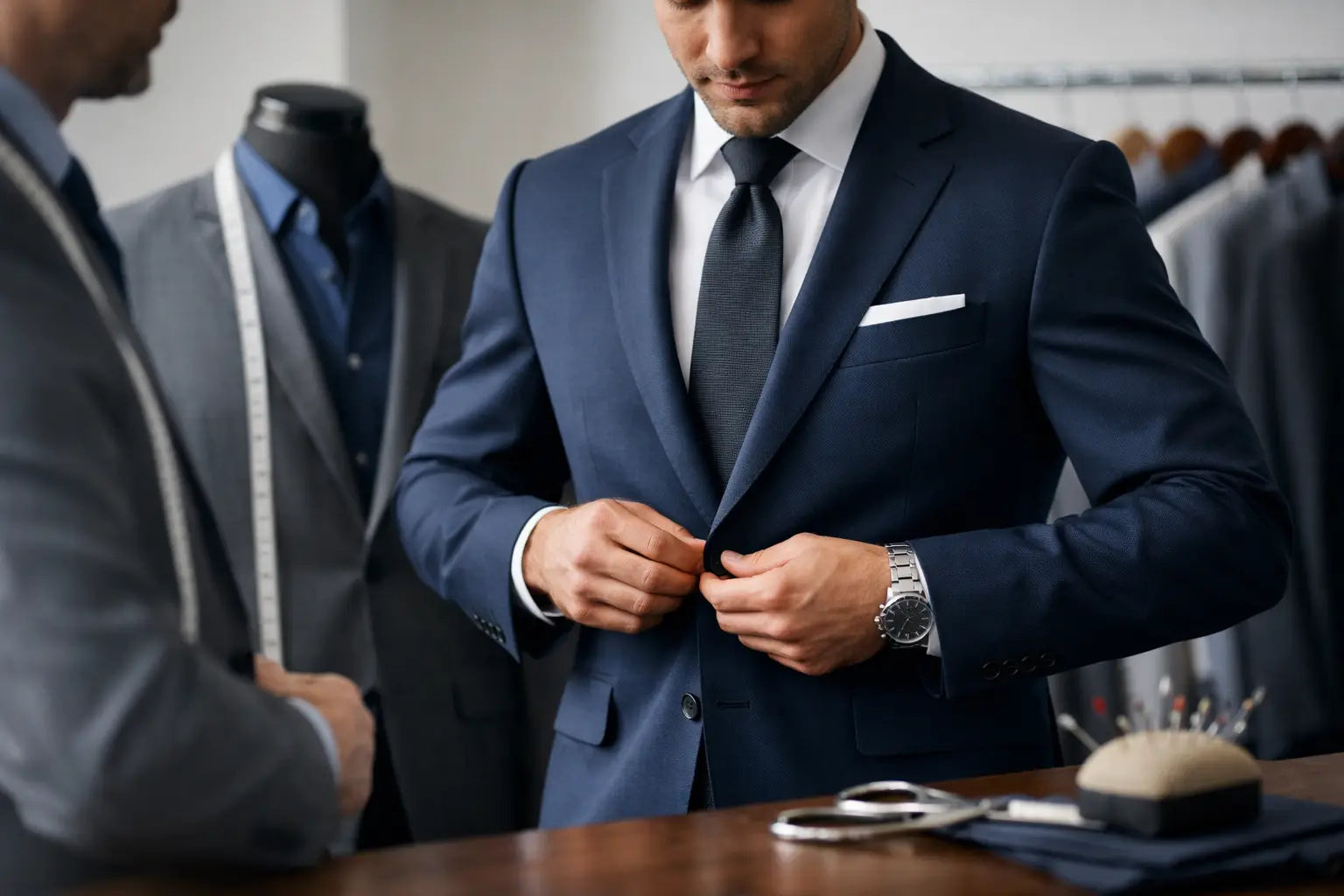
A well-cut jacket broadens the upper frame without exaggeration. It creates structure through the chest and shoulder while allowing natural movement. Trousers lengthen the line rather than bunch at the ankle. Sleeves reveal just enough shirt cuff to suggest precision. Each element contributes to a message of discipline and discernment.
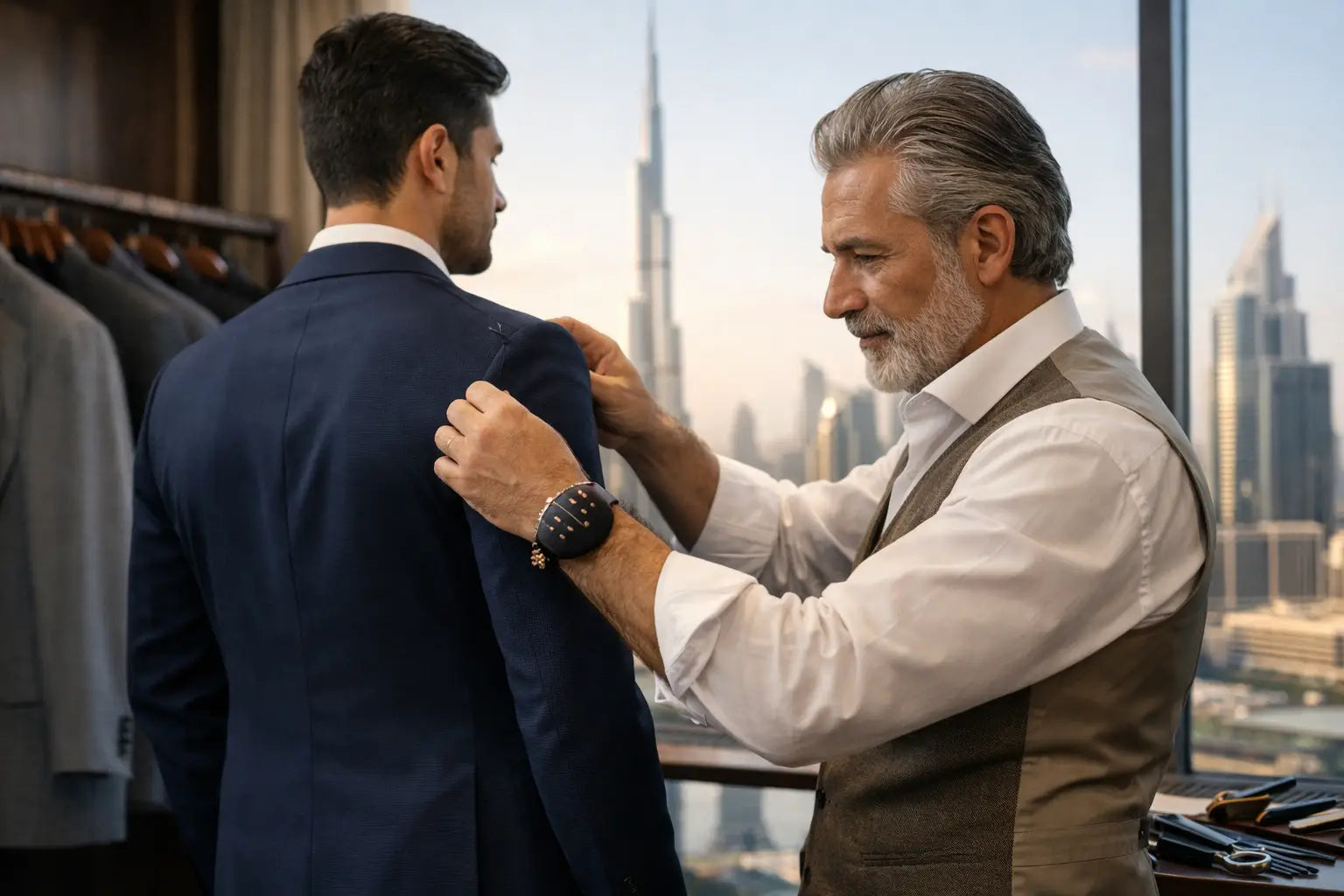
This is particularly relevant in cities such as Dubai, where the standards of business dress can be exceptionally high and personal presentation carries real commercial weight. In such environments, the distinction between expensive clothing and considered tailoring becomes very clear. One signals access. The other signals judgement.
There is, of course, a balance to strike. A suit cut too aggressively can appear self-conscious. One cut too softly may lose presence in formal or competitive settings. The right expression depends on industry, seniority and temperament. Tailoring is valuable precisely because it allows these calibrations.
The role of cloth, cut and consultation
Professional presence through tailoring does not begin at the fitting room mirror. It begins earlier, in the decisions that shape the garment from the outset. Cloth, cut and consultation each carry equal importance.
Fabric affects not only appearance, but behaviour. A lightweight cloth may feel elegant in a private office but lose its shape during long days of travel and meetings. A heavier wool often drapes more cleanly and holds its line, though it may not suit every climate or schedule. Texture matters as well. Smooth worsteds offer formality and clarity. Fresco, hopsack and high-twist wool bring breathability and character, though with a slightly more relaxed visual language.
Cut determines how the suit frames the body. This is where true bespoke separates itself from made-to-measure. Rather than adjusting a pre-existing block, bespoke creates a pattern from the individual. It accounts for asymmetry, stance, shoulder angle and preference. A man who stands upright and moves decisively should not wear the same cut as one with a softer posture and more relaxed bearing. The suit must support the man truthfully, not impose a borrowed shape.
Consultation is where image becomes specific. A skilled tailor will ask how often the garment will be worn, where it will be seen, what message it should carry and how the client wishes to feel in it. This is not indulgence. It is design intelligence. The best tailoring is not simply well made. It is well interpreted.
Presence is felt in comfort as much as appearance
Many men tolerate discomfort in exchange for looking formal. They accept tight armholes, dragging collars or waistbands that become punishing by mid-afternoon. This is a mistake. Discomfort changes posture, movement and concentration. It enters the room with you.
A properly tailored garment allows ease without visual excess. The wearer should be able to sit, reach, travel and work without the suit losing composure. Comfort has an aesthetic value because it changes how a man carries himself. He stands more naturally, moves with less hesitation and appears at ease in his own position.
This is one of the quiet luxuries of bespoke. It creates garments that perform under real conditions rather than only under showroom lighting. For clients who spend long hours between meetings, flights and formal engagements, that distinction matters greatly.
When tailoring becomes part of personal identity
The finest wardrobes do not rely on constant novelty. They are built around consistency. Over time, tailoring becomes a visual signature - not a uniform in the dull sense, but a recognisable standard. People begin to associate a man with clarity, taste and reliability because his appearance never feels arbitrary.
This does not mean every suit should look the same. Variation has its place. A charcoal suit for serious negotiations, a mid-grey for daily executive wear, a deep navy for versatility, perhaps a subtle check for private dinners or less formal appointments. What matters is coherence. The wardrobe should reflect one identity, not several competing versions of it.
This is where a bespoke relationship becomes especially valuable. As the tailor understands the client more deeply, each commission becomes more precise. The process grows more intuitive. Details sharpen. The wardrobe evolves with the man rather than around seasonal fashion.
For this reason, many discerning clients do not seek bespoke because they need more clothing. They seek it because they want greater control over how they are seen. That is a different objective altogether, and a more meaningful one.
The lasting value of professional presence through tailoring
There are cheaper ways to dress formally. There are faster ways as well. But neither necessarily produces presence. Professional presence through tailoring is an investment in visual credibility, physical ease and personal distinction. It respects the fact that serious men are judged on subtleties long before credentials are discussed.
At DONFIORITO, this philosophy sits at the heart of bespoke service: a garment should fit the body precisely, but it should also fit the life, the standards and the image of the man wearing it. That is the true measure of luxury.
When your clothing is cut with intention, you do not need to ask whether you look the part. You are free to focus on what matters more - entering the room with quiet certainty and being remembered for exactly the right reasons.