Luxury Tailoring Dubai for Men Who Lead
A suit can be expensive and still feel anonymous. That is the weakness of standard luxury menswear, particularly for men whose calendar moves between boardrooms, private dinners, ceremonies and travel. Luxury tailoring Dubai has become less about buying a fine garment and more about commissioning one that reflects authority, discretion and personal character.
For the man who is seen before he is heard, fit is not a detail. It is part of the message. The line of a jacket, the balance of the trouser, the way cloth responds when you sit, stand and move - these are quiet signals, but they are noticed. A truly bespoke garment is built entirely around the body it belongs to, and that distinction changes everything.
What luxury tailoring in Dubai should really mean
In a city where standards are high and appearances carry weight, the phrase luxury tailoring is often used too loosely. Fine fabric alone is not luxury. Nor is a made-to-measure adjustment presented as something more rare than it is. True luxury lies in authorship, precision and the quality of the experience from first consultation to final delivery.
A bespoke garment begins with an individual pattern drafted for one client and one client only. It takes into account posture, shoulder expression, arm position, movement, preference and purpose. The result is not simply a better fit than ready-to-wear. It is a different category of clothing entirely.
That matters because affluent clients are not usually searching for more choice. They are searching for fewer compromises. They have worn suits that looked excellent on a hanger but felt restrictive by midday. They have paid for labels only to receive silhouettes that flatten personality rather than sharpen it. Bespoke tailoring answers a more sophisticated question: not what is fashionable, but what is correct for the man wearing it.
Why high-performing men choose luxury tailoring Dubai
There is a practical reason successful men return to bespoke. Time is limited, expectations are not, and presentation has consequences. Whether the setting is corporate, social or ceremonial, clothing influences how a man occupies space and how others respond to him.
A proper tailor does more than measure chest and waist. He interprets image. Some clients want a sharper silhouette with stronger presence through the shoulder. Others prefer understatement - soft authority rather than overt structure. Some require garments that travel well and remain composed through long working days. Others want evening pieces with depth, elegance and restraint. The point is not excess. It is calibration.
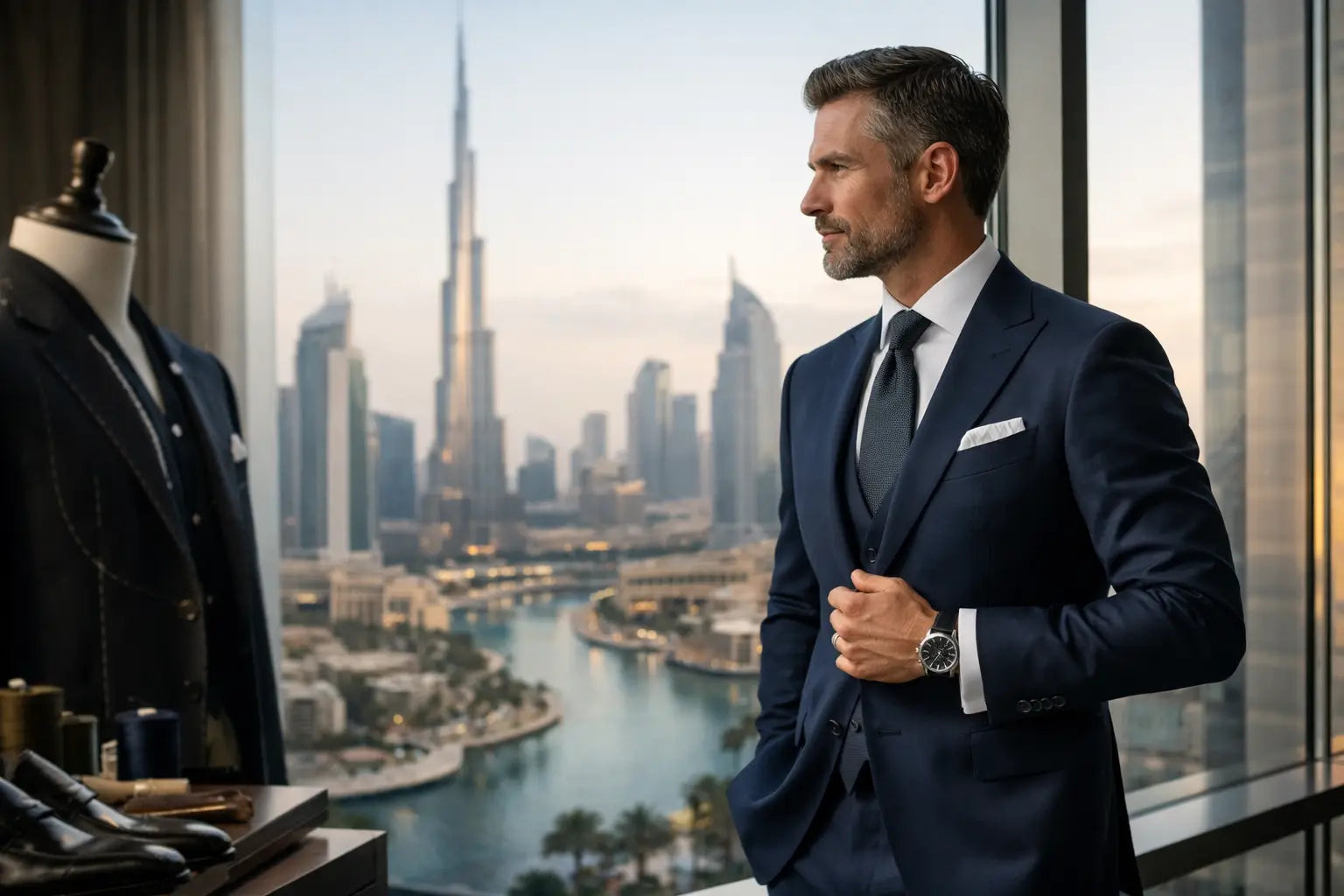
Dubai is a city of contrasts - formal meetings in intense heat, indoor environments with heavy air conditioning, and events that move from daylight to late evening. Bespoke tailoring allows these realities to be considered from the beginning. Cloth weight, lining choice, construction and cut all need to respond to lifestyle, not merely aesthetics.
That is where the difference becomes tangible. A suit made for your actual life performs better than one made for an imaginary standard body and an abstract idea of luxury.
The bespoke process and why it matters
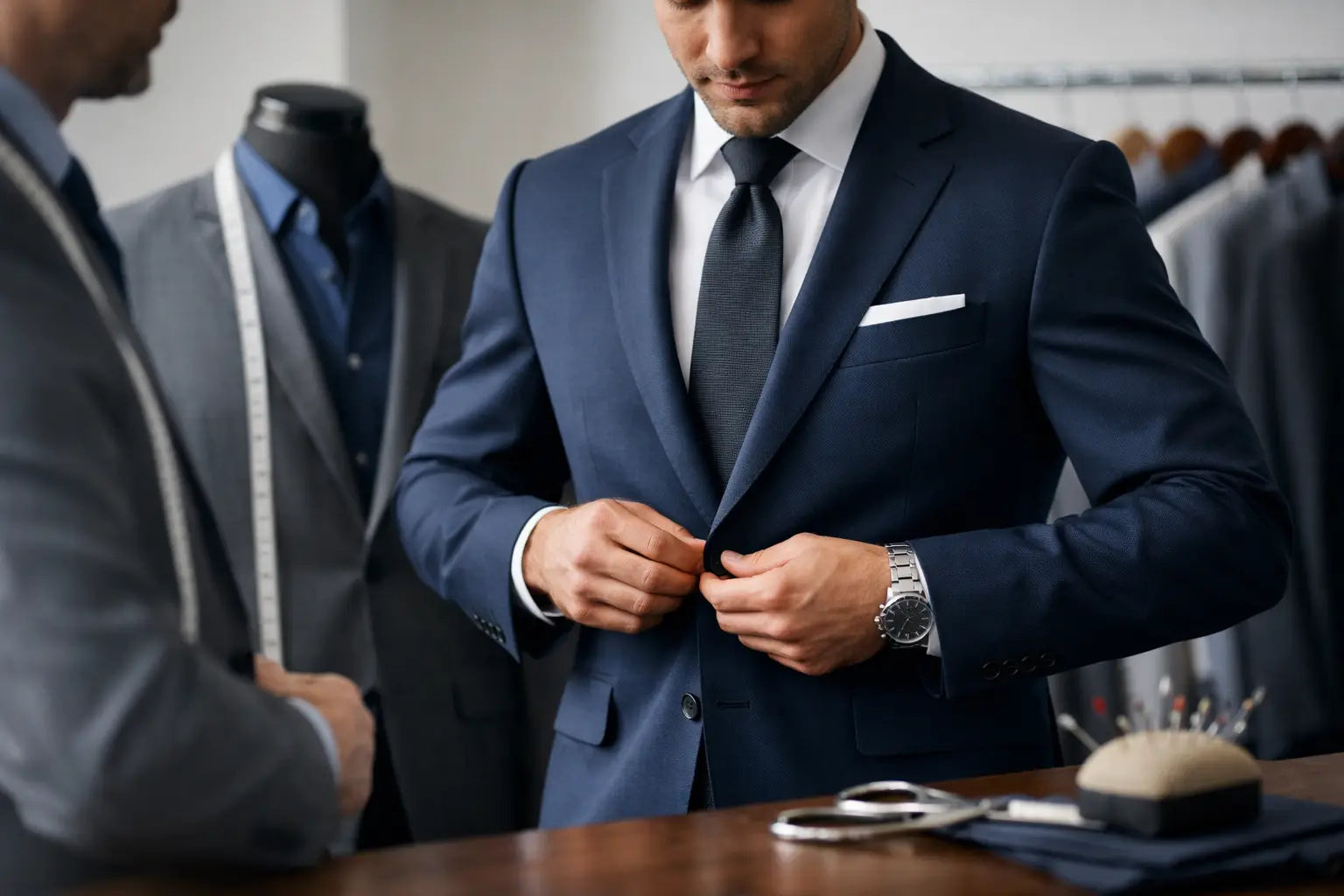
The finest tailoring houses understand that confidence is built gradually. It starts with a private consultation, not a sales pitch. This first conversation establishes more than measurements. It defines intent. What should the garment communicate? Where will it be worn? How should it feel on the body? What has disappointed the client in the past?
From there, fabric selection becomes a strategic decision rather than an indulgent one. Texture, drape and seasonality all matter, but so does image. A business suit in a deep navy with a clean, controlled finish speaks differently from a richer cloth with visible character. Neither is inherently superior. It depends on the man, the environment and the role the garment must play.
Consultation, fitting and refinement
The first fitting is where tailoring reveals its seriousness. At this stage, the client sees whether the house understands proportion and posture or merely follows generic formulas. The collar must sit cleanly. The chest should have shape without tension. The sleeve should fall with purpose. Trousers should lengthen the line of the leg, not interrupt it.
Several refinements may be required, and that is not a flaw in the process. It is evidence of care. Precision rarely arrives in a single step. The best results come from patient correction, controlled judgement and a refusal to accept almost right.
Final delivery should feel inevitable rather than surprising. The garment should sit as though it belongs to the client because, in every meaningful sense, it does.
Bespoke, made-to-measure and ready-to-wear are not equal
Clients often ask whether bespoke is necessary when made-to-measure appears more convenient. The honest answer is that it depends on expectations. Made-to-measure can improve fit over ready-to-wear and may suit men with straightforward proportions and limited requirements. For some wardrobes, it is a reasonable solution.
But it is still built from an existing block. It adjusts a template. Bespoke creates one. For men with developed physiques, asymmetry, exacting standards or a highly specific visual identity, that distinction is significant. The garment is not adapted to them after the fact. It originates with them.
Ready-to-wear, by contrast, offers speed and accessibility, but the trade-off is obvious. The wearer must surrender to the assumptions of the manufacturer. Shoulder line, button stance, lapel shape, trouser rise and jacket length are all decided in advance. Alterations may improve the result, yet they rarely transform the underlying architecture.
In luxury, the question is rarely what costs less. It is what serves best over time.
How to judge a true luxury tailor
A refined tailoring house does not begin by showing endless options. It begins by asking better questions. Taste matters, but judgement matters more. The right tailor will know when to guide, when to challenge and when to remain restrained.
Look closely at how the service is structured. Private appointments, thoughtful pacing and continuity across consultations are not theatrical extras. They protect the quality of the outcome. A client should feel that the process is controlled, discreet and centred on him.
Equally, examine how the tailor speaks about fit. If the conversation remains superficial - colours, buttons, trends - something is missing. A serious tailor discusses silhouette, balance, comfort and perception. He understands that a garment affects not only appearance but behaviour. Men stand differently in clothing that has been cut with intelligence.
This is also where house style becomes relevant. Every bespoke tailor has one, even when claiming neutrality. Some cut with strong structure and formal presence. Others favour softness and ease. Neither is universally right. The important thing is alignment. The tailor's philosophy should strengthen the client's identity rather than impose a costume upon it.
One name often associated with this level of service is Don Fiorito, where the bespoke experience is shaped around personal consultation, precision fitting and garments created to express individual presence with clarity.
Luxury tailoring Dubai beyond the suit
The most considered wardrobes are not built from isolated purchases. They are composed over time. Once a tailor understands the client properly, the relationship can extend beyond the foundational navy or charcoal suit into dinner jackets, separates, coats, shirts and occasionwear.
This continuity matters because elegance is cumulative. A man may begin with one business suit and later require garments for travel, weddings, black-tie evenings or private events. When each piece is designed with awareness of the others, the wardrobe becomes coherent. It feels less like shopping and more like commissioning a personal standard.
There is also an emotional value that should not be dismissed. Bespoke clothing changes the experience of dressing. It removes friction. It quietens second-guessing. The client does not stand in front of a mirror wondering whether the jacket is pulling or whether the trouser break is wrong. He puts it on and gets on with the day.
That certainty is a form of luxury in itself.
The men who invest in luxury tailoring are not chasing ornament. They are choosing precision in an area of life where precision pays visible dividends. In a city that recognises presence immediately, the right garment does not ask for attention. It commands respect through proportion, restraint and exactness. If your wardrobe no longer reflects the level at which you operate, that is usually the moment bespoke becomes the correct decision.