Custom vs Bespoke Suit - What Really Matters
A suit can look expensive and still feel wrong the moment you move. The shoulder resists, the sleeve breaks poorly, the jacket follows a standard shape rather than your own. That is where the question of custom vs bespoke suit becomes more than terminology. It becomes a question of how precisely a garment is built around the man wearing it.
For clients who understand that presentation is part of influence, the distinction matters. Not because one term sounds grander than the other, but because the process behind each produces a different result. If you expect a suit to do more than simply fit at first glance, you need clarity before you commission one.
Custom vs bespoke suit - the difference in plain terms
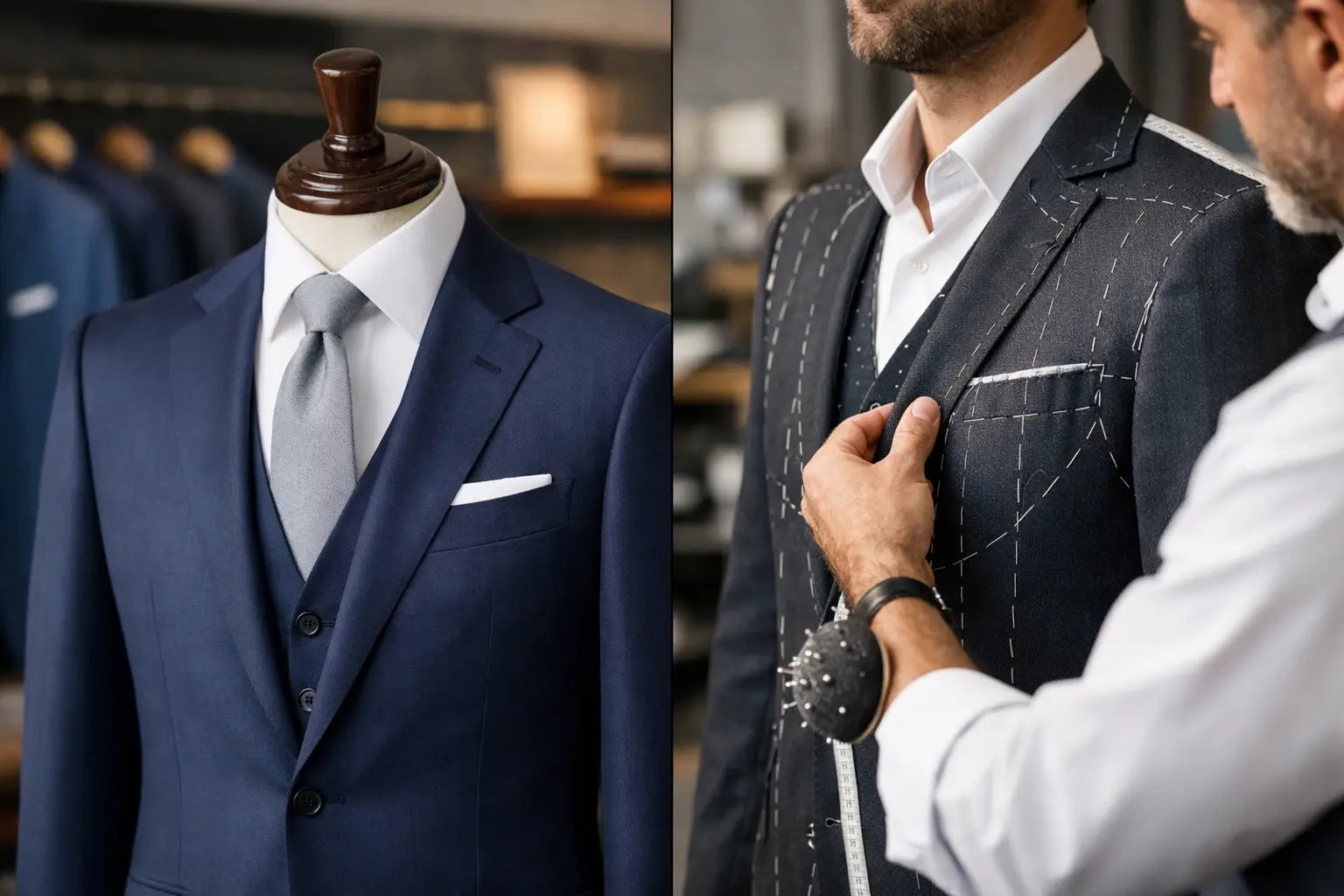
The simplest way to understand it is this. A custom suit usually begins with an existing block or base pattern that is adjusted to your measurements and preferences. A bespoke suit is built from a unique pattern drafted specifically for your body, posture and proportions.
That difference may appear subtle on paper. In practice, it changes everything. A custom garment can offer a strong level of refinement and is often a considerable step above ready-to-wear. Yet bespoke sits in another category because it does not ask your body to adapt to a pre-existing template. It starts with you.
This is why two garments can both be described as made for the client, while delivering entirely different levels of fit, balance and comfort. One is modified. The other is conceived.
Why the distinction matters more than the label
In luxury menswear, language is often used generously. Some houses describe almost any made-to-measure service as bespoke. For the client, that creates confusion, especially when the visual difference is not immediately obvious on a hanger.
The real measure is not the label. It is the construction method, the pattern work and the fitting process. If a suit is cut from an individual paper pattern drafted for you, refined through fittings and adjusted according to how your body stands and moves, you are in bespoke territory. If alterations are being made to a standardised starting point, it is custom or made-to-measure.
Neither is inherently wrong. The better question is what you require from the garment. A man with balanced proportions and straightforward preferences may be well served by custom. A man with a developed physique, a sloping shoulder, a prominent seat, or very exacting standards will often notice the limits of that system quickly.
How a custom suit is typically made
A custom suit generally begins with a pre-established model. Your chest, waist, seat, sleeve and trouser measurements are taken, then those figures are used to alter an existing block. You usually choose cloth, lining, lapel shape, buttons and other design details, which gives the garment a personal character.
This route has clear advantages. It is usually faster than bespoke, often more accessible in price, and can produce a polished result when handled by a skilled tailor. For many clients, especially those moving beyond ready-to-wear for the first time, custom feels like a meaningful improvement.
Its limitation lies in the foundation. Because the pattern already exists, the tailor is refining a system rather than creating a fresh architectural plan. The garment may fit very well, but it is still working within inherited proportions. If your body falls outside those assumptions, the compromise can appear in the drape, the collar, the balance of the coat, or the way the trouser line behaves when standing and sitting.
Where custom performs well
Custom is often a sensible choice for business wardrobes that require efficiency. If you know the silhouette that suits you, need several garments within a shorter timeframe, and your fitting issues are minor rather than structural, custom can be highly effective.
It is also useful for men who want consistency across multiple suits. Once a strong adjusted block is established, it can be repeated with different fabrics and seasonal variations.
What makes a bespoke suit different
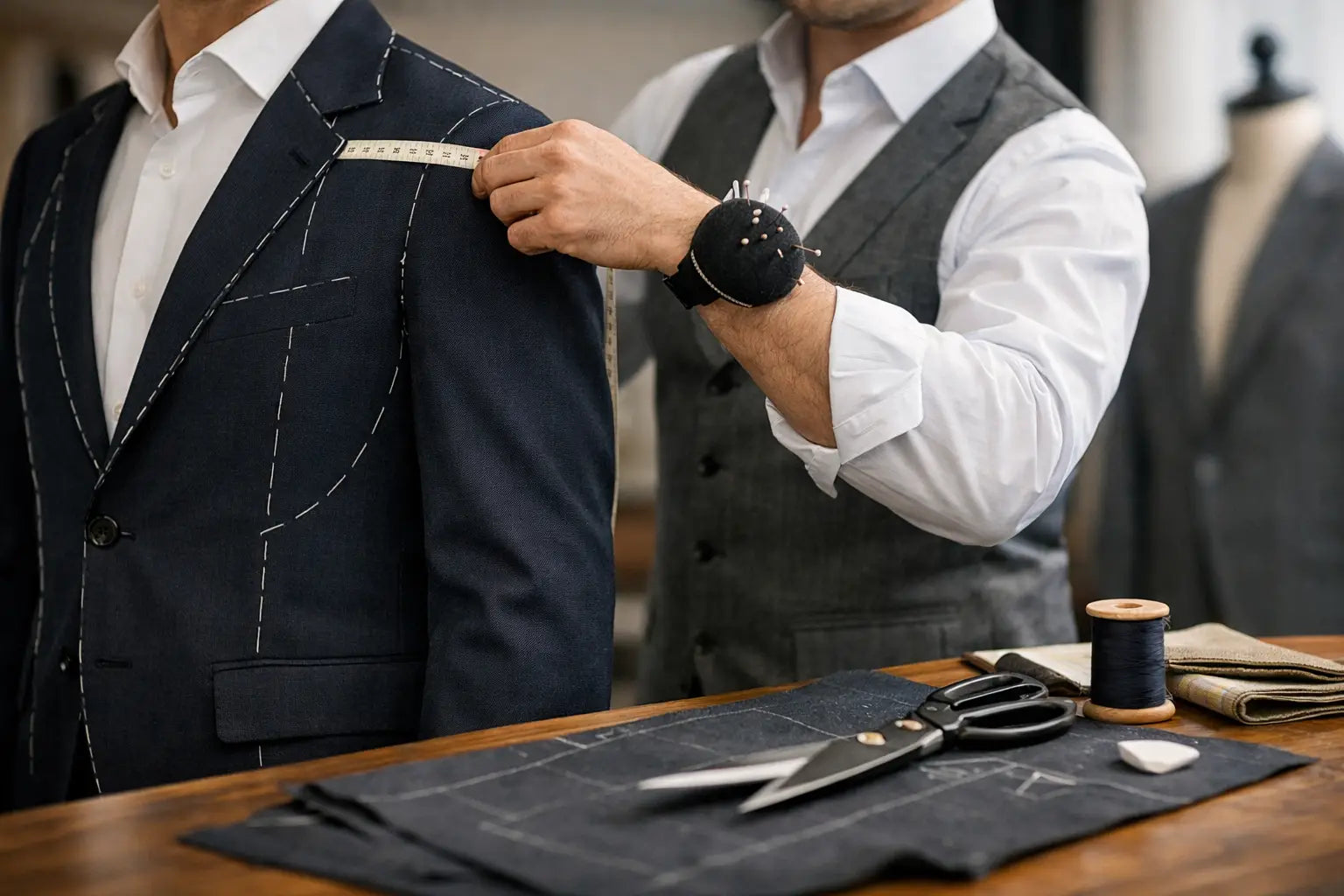
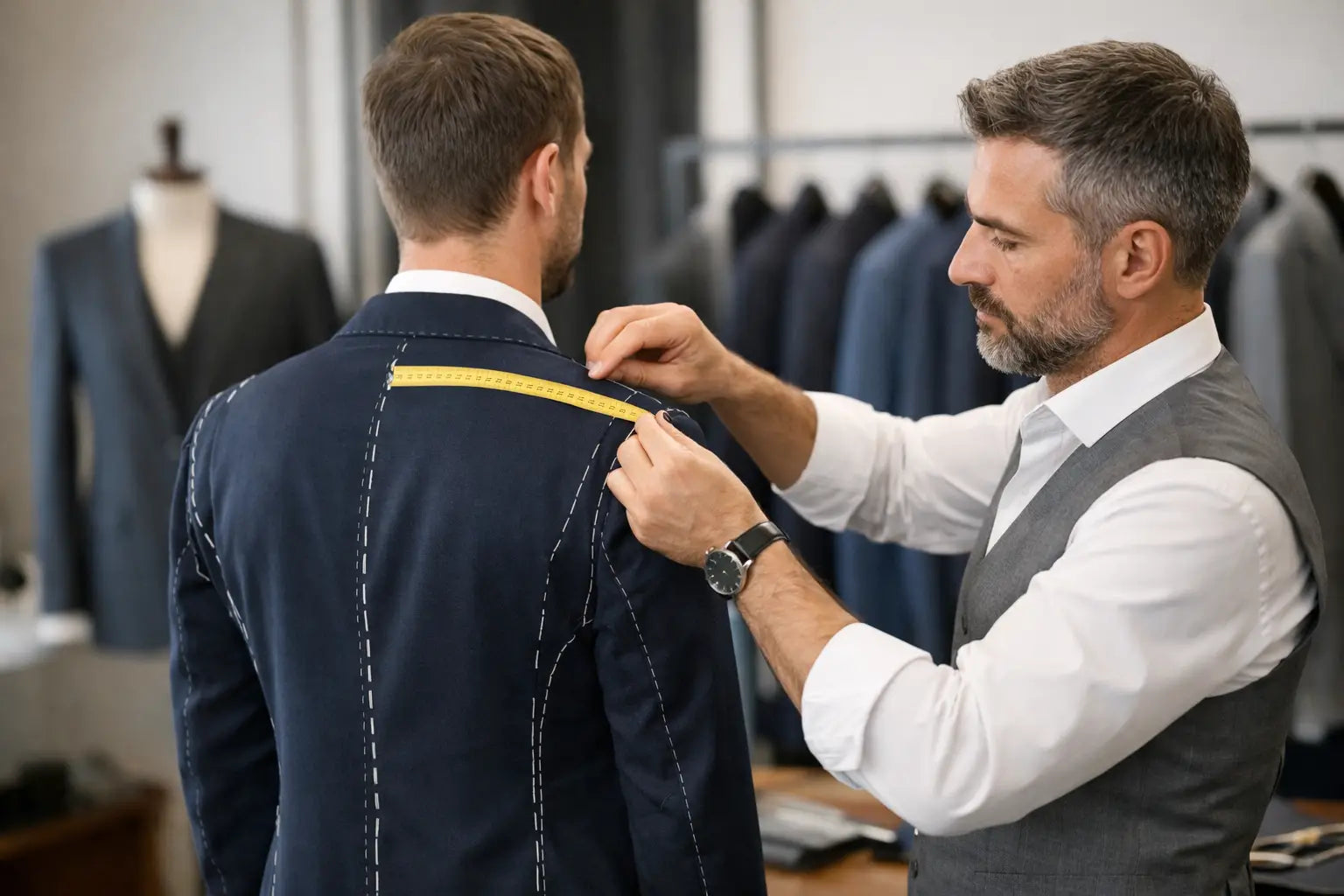
A bespoke suit begins with observation before measurement. A skilled tailor studies your posture, shoulder expression, stance, gait and the way your body carries cloth. Measurements are only one part of the conversation. The rest comes from trained judgement.
From there, an individual pattern is drafted for you alone. That pattern becomes the basis of the garment and evolves through fittings. During these stages, balance is corrected, suppression is refined, pitch is adjusted, and the silhouette is shaped not just to your dimensions but to your presence.
This is the point many clients only fully appreciate once they have worn true bespoke. The garment does not merely sit on the body cleanly. It behaves correctly. The collar stays close to the neck. The chest feels composed rather than strained. The line remains elegant in motion. Comfort improves because the suit has been built in dialogue with the body rather than imposed upon it.
Bespoke is also a question of expression
A bespoke suit is not simply tighter, slimmer or more luxurious. It is more intentional. The cutter can decide how authority should appear in the shoulder, how restraint should show in the waist, and how length should frame the client’s proportions. These decisions affect the impression you make long before anyone notices the cloth.
For a senior executive, that may mean a quieter shape with controlled structure. For an entrepreneur with a more visible personal brand, it may involve sharper definition and a stronger silhouette. Bespoke allows those choices to be embedded into the cut itself.
Custom vs bespoke suit - which offers better value?
Value in tailoring is not only about price. It is about how much precision, longevity and confidence the garment returns over time.
A custom suit may represent excellent value when the objective is quality, speed and a distinct improvement over standard luxury retail. It can be the right answer for travel wardrobes, regular office rotation, or clients who need a reliable suit without the full commitment of a bespoke commission.
A bespoke suit commands more because it involves greater expertise, pattern development, handwork and fitting time. Yet for the client who notices proportion, who expects comfort without compromise, and who wants the suit to project identity with accuracy, the return is often greater. A well-cut bespoke garment earns its place not through novelty but through repeated use. You reach for it because it looks right, feels right and asks for nothing once it is on.
That is usually where the real economy appears. Fewer disappointing purchases. Fewer garments left in the wardrobe after one season. Better performance on the occasions that matter most.
The fitting process tells you what you are buying
If you want to know whether you are commissioning custom or bespoke, pay attention to the appointments. The process reveals the truth.
A custom service will usually involve measurement, style selection and one or two fittings. A bespoke service tends to be more exacting. The first consultation is deeper. The fitter studies not only size but attitude, requirement and context. Intermediate fittings are used to refine the cut rather than simply confirm that the garment can be finished.
This is where a house such as DONFIORITO distinguishes itself. The experience is not built around selling a suit quickly. It is built around reading the client properly, shaping the silhouette with intent and delivering a garment that feels composed in every setting from boardroom to formal evening engagement.
Which should you choose?
The honest answer is that it depends on how you live, how your body is built, and how much the outcome matters to you.
If you want a strong suit with sensible efficiency, custom may be entirely appropriate. If your wardrobe needs range, repetition and shorter lead times, there is nothing lesser about making that choice deliberately.
If, however, your standards are exacting, your fit challenges are specific, or your public image is too important to leave to approximation, bespoke becomes the more intelligent option. Not because it is more exclusive for its own sake, but because it offers a level of precision that standard systems cannot fully replicate.
The men who value bespoke most are rarely chasing extravagance. More often, they are avoiding compromise. They know that authority is communicated in millimetres - in the clean shoulder, the decisive waist, the trouser that falls without disturbance, the jacket that stays elegant from first meeting to final dinner.
When considering custom vs bespoke suit, the question is not which sounds more prestigious. It is which process respects your body, your standards and the way you intend to be seen. Choose the one that leaves no doubt when you catch your reflection.