From Poor Fit to Confidence
A suit can be expensive, made from a fine cloth, and carry the right label - yet still diminish the man wearing it. The shift from poor fit to confidence rarely begins with fashion. It begins with proportion, posture, and the quiet authority that comes from wearing something built properly around the body.
For many men, the problem is not a lack of taste. It is the accumulated compromise of ready-made clothing. Trousers pull where they should fall cleanly. Jackets collapse at the shoulder or grip too tightly across the chest. Sleeves sit awkwardly. The collar drifts from the neck. None of these details announces itself loudly, yet together they alter how a man is seen and, more importantly, how he carries himself.
Why poor fit affects more than appearance
An ill-fitting garment does more than spoil a silhouette. It creates friction. You adjust the cuff before a meeting. You tug at the jacket when standing. You become aware of cloth rather than the conversation in front of you. That distraction has a cost.
Confidence in dress is often misunderstood as vanity. In reality, it is closer to alignment. When the line of a jacket is clean, when the waist sits correctly, when the drape follows the body without strain, a man stops negotiating with his clothes. He can simply wear them.
This is especially true in environments where first impressions carry weight. Boardrooms, private events, formal dinners, investor meetings - these are settings in which clothing is never merely decorative. It signals judgement, self-respect, and an understanding of context. A poor fit can suggest haste or indifference, even when neither is true.
From poor fit confidence: what changes first
The transformation from poor fit confidence is not instant theatre. It is usually quieter than that. The first change is physical ease.
A properly made jacket sits at the shoulder rather than fighting it. The chest has room where it should, shape where it must, and restraint where excess fabric would weaken the outline. Trousers follow the leg with intention rather than clinging or ballooning. The result is comfort, but a very specific kind of comfort - one that supports presence rather than softness.
The second change is visual balance. Bespoke tailoring does not chase a generic ideal. It corrects and refines according to the individual man. A forward shoulder, a prominent seat, one arm lower than the other, a stronger chest, a fuller midsection - these are not flaws. They are realities of the body, and a skilled tailor works with them rather than pretending they do not exist.
Only after those two changes comes the psychological shift. When a garment no longer distracts, a man tends to become more direct. His posture improves naturally. His movements look considered rather than tentative. He enters a room without the subtle self-consciousness that poor fit so often creates.
The hidden cost of wearing the wrong suit
Most men can identify obvious problems in a suit, but the more expensive mistakes are often the less visible ones. A jacket that appears acceptable while standing still may distort the moment the wearer moves. Trousers may look clean at first glance yet break badly over the shoe or twist through the leg. A waist suppression that seems flattering in the fitting room may become restrictive over the course of a long day.
This is why off-the-peg and made-to-measure solutions do not always solve the issue. They can improve certain dimensions, but they still begin with a pre-existing block. If the foundation is wrong, the refinement has limits.
For a client with a demanding schedule, the consequences are practical as much as aesthetic. He needs garments that perform from morning through evening, while seated, standing, travelling, and hosting. He needs consistency. He should not have to wonder whether his jacket will hold its line by midday.
There is also the matter of identity. Luxury clients are rarely looking for clothing simply to cover the body. They want garments that express authority without effort, discretion without dullness, and distinction without noise. Poor fit undermines all three.
Why bespoke restores authority
True bespoke begins with observation. Before cloth, before style decisions, before details, there is the question of how a man lives and how he wishes to be perceived. That is the point at which tailoring becomes more than measurement.
A bespoke pattern is built entirely around the body it belongs to. This matters because two men of similar height and weight can require entirely different solutions. One may need more structure through the shoulder, another less. One may benefit from a stronger waist definition, another from a cleaner, straighter line. Precision is not about making every garment tighter or sharper. It is about making it right.
This is where authority returns. The suit stops behaving like a rented version of formality and starts feeling like a natural extension of the wearer. Lapels frame the chest correctly. The jacket length supports stature. The balance from front to back is considered. Even small adjustments in sleeve pitch or trouser rise can alter the entire impression.
The finest result never looks laboured. It looks inevitable.
Fit is not tightness
One of the more persistent misunderstandings in menswear is the idea that a close fit equals a good fit. It does not. A suit that is too tight often appears more expensive in photographs and far less elegant in person.
Good tailoring leaves enough room for movement, breath, and composure. The cloth should skim, not strain. The jacket should shape the torso without imprisoning it. Trousers should lengthen the leg, not cling to it. A man in a well-cut suit should look assured, not squeezed into ambition.
This distinction matters more with mature, successful clients who understand that real luxury is ease. There is no sophistication in looking uncomfortable. Presence comes from control, and control begins with garments that respond well to the body over time.
The role of fittings in moving from poor fit to confidence
No serious bespoke process is complete after a single conversation. Fittings exist because the body is three-dimensional, because posture changes in motion, and because refinement requires judgement.
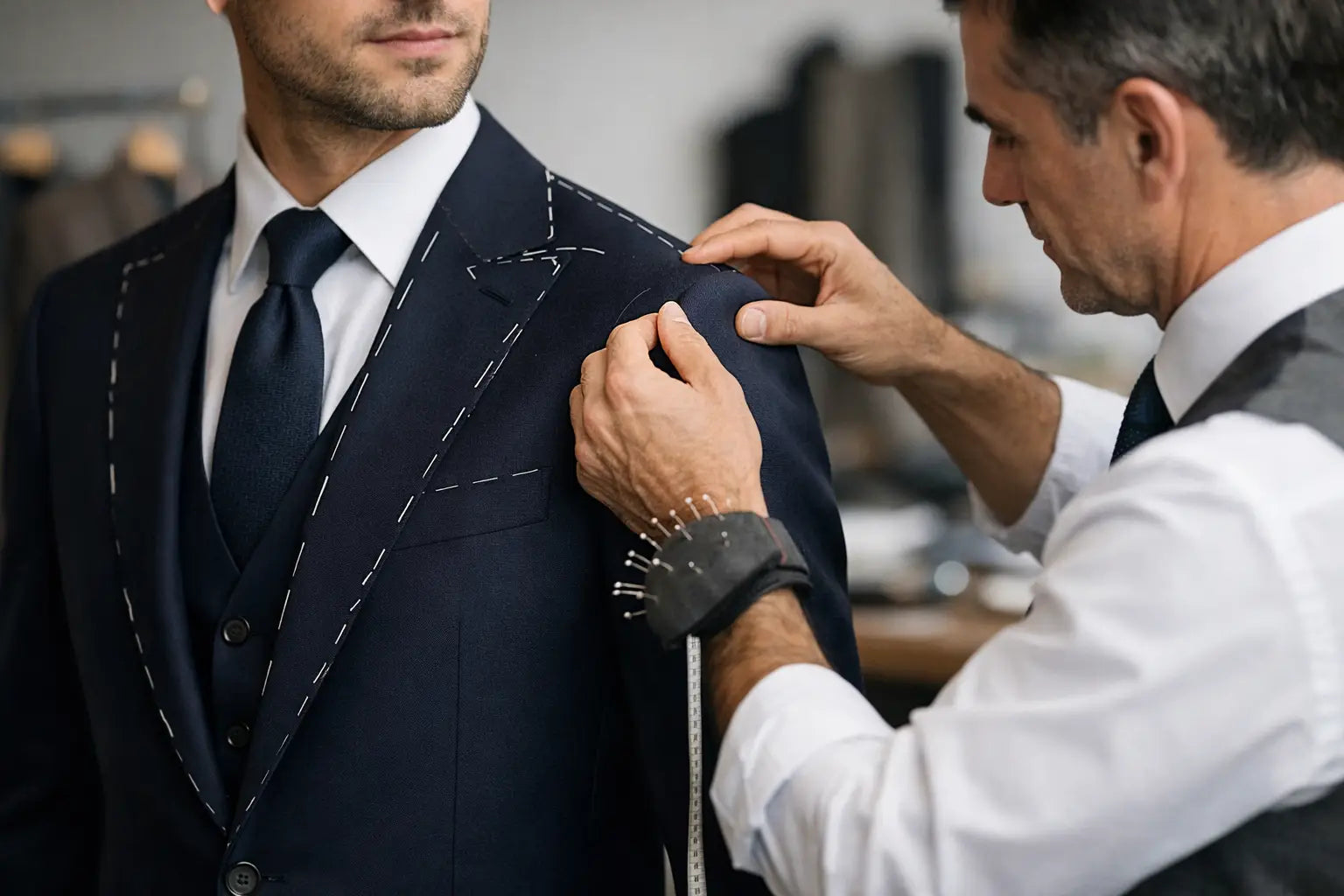
At the first fitting, the garment begins to reveal its architecture. Balance, suppression, sleeve fall, trouser line, collar position - all are assessed not as isolated features, but as part of one coherent silhouette. The second fitting often brings subtle but decisive corrections. A few millimetres can sharpen the line of the shoulder, improve the drape of the back, or restore calm to the front of the coat.
This stage is where many men first understand the difference between clothing bought and clothing crafted. Bespoke is not a transaction. It is a process of calibration.
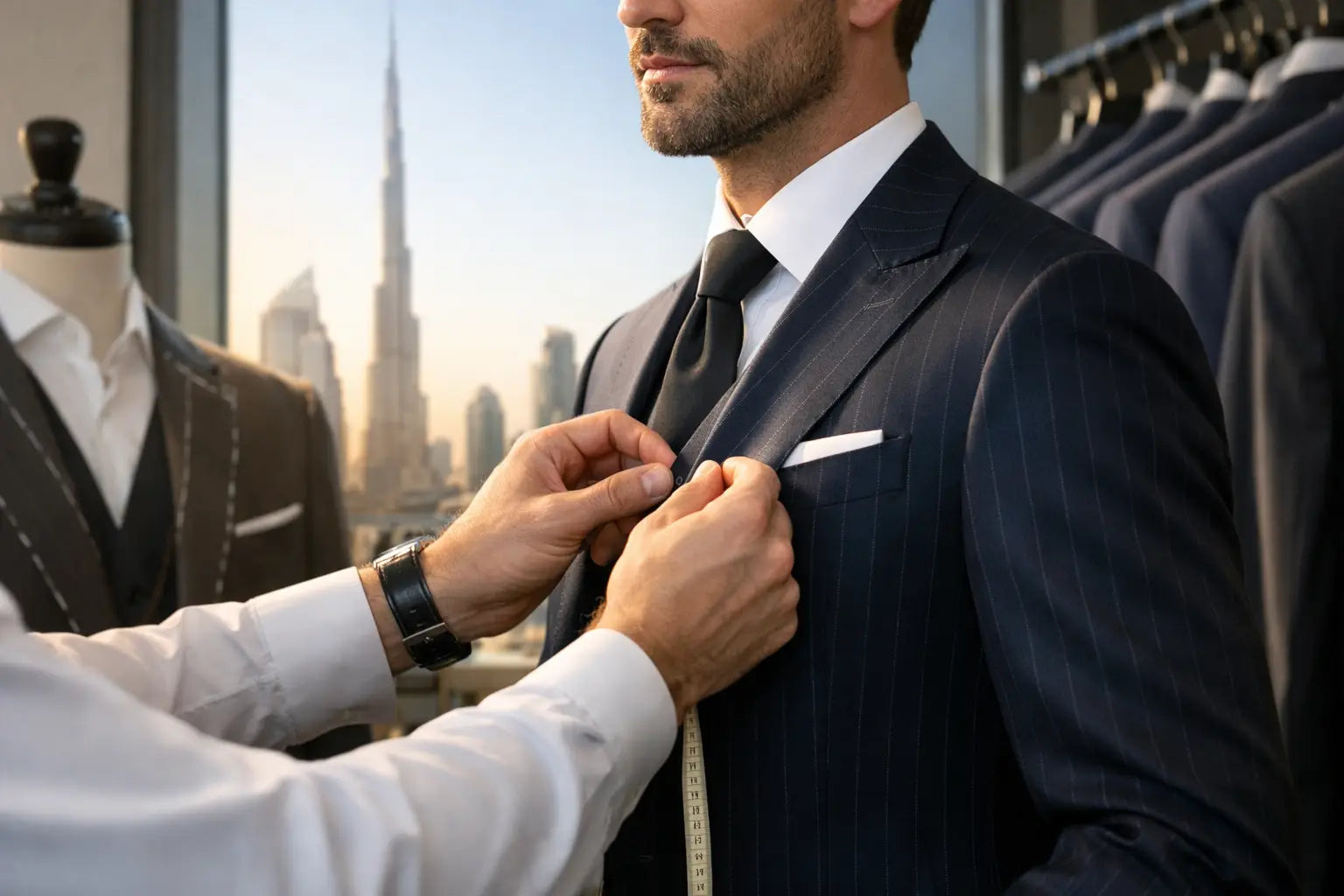
For clients in Dubai, where the social and business calendar often requires polished dressing under demanding conditions, that calibration has particular value. Cloth choice, internal structure, and cut must all work with climate, schedule, and setting. Elegance is easier to maintain when these variables have been considered from the beginning.
What confidence looks like in practice
Confidence in tailoring is not flamboyance. It is the absence of hesitation.
A man who trusts his suit stands differently. He does not keep checking his cuff or fastening his jacket merely to correct its line. He does not feel compelled to overcompensate with loud accessories or trend-driven details. The garment has already done the work of establishing seriousness and refinement.
That confidence also has range. It matters in a negotiation, but equally at a wedding, an intimate dinner, or a formal reception. The suit does not need to announce wealth to express discernment. In fact, the most persuasive tailoring rarely shouts. It communicates through precision, cloth, and proportion.
This is why the relationship between fit and confidence is so enduring. Men do not remember every technical detail of a garment. They remember how it made them feel in consequential moments. Composed. Credible. Entirely themselves, only more assured.
A well-made suit cannot provide character, but it can remove the distractions that keep character from being seen clearly. That is a more powerful service than fashion usually admits.
The journey from poor fit to confidence is not about becoming someone else. It is about dressing in a way that finally reflects the man already there - with clarity, comfort, and quiet command.