What Is Bespoke Suits and Why It Matters
A suit can fit your measurements and still fail to fit you. That distinction is at the heart of the question, what is bespoke suits, because true bespoke is not simply a matter of size. It is a garment built entirely around the body it belongs to, the way it moves, and the impression its wearer intends to create.
For men whose appearance carries weight in business, formal settings, and private life, that difference is not cosmetic. It is strategic. A bespoke suit is made from a unique pattern drafted for one individual alone, then refined through fittings until the silhouette, balance, and comfort feel completely resolved.
What is bespoke suits in practical terms?
If the phrase sounds slightly awkward, the meaning is straightforward. When clients ask what is bespoke suits, they are usually asking what makes a suit genuinely bespoke rather than simply customised.
A bespoke suit begins from nothing. There is no standard block, no pre-existing template, and no assumption that your body should adapt to a house size. Instead, a tailor takes detailed measurements, studies posture and proportion, discusses preference and use, and drafts a personal pattern. That pattern belongs to you.
From there, the cloth is cut for your garment alone. The suit is assembled in stages and adjusted through fittings, often more than once, so that the final result reflects not only your dimensions but your bearing. Shoulder expression, chest shape, waist suppression, trouser line, sleeve pitch, jacket length - these decisions are considered in relation to the individual, not to a stock model.
That is why bespoke sits at the highest end of tailoring. It is not only more labour-intensive. It is more personal, more exacting, and far less tolerant of approximation.
Bespoke, made-to-measure and ready-to-wear are not the same
Much of the confusion around bespoke comes from the way the word is used in modern menswear. Many garments are described as bespoke when they are, in reality, adjusted versions of something standard.
Ready-to-wear is the simplest category. The suit is produced in fixed sizes and sold off the rail. Minor alterations may improve the fit, but the garment was never conceived for your body. For some men, especially those with very balanced proportions, this can be acceptable. For many others, it leaves visible compromises in the shoulders, collar, waist, sleeve pitch or trouser drape.
Made-to-measure goes a step further. A standard pattern is modified according to your measurements. This can produce a cleaner result than ready-to-wear and, in the right circumstances, it may serve a practical purpose. But it still begins with an existing block. The garment is adjusted to suit you, not created exclusively for you.
Bespoke is different in principle. The pattern is drafted from the beginning for one client. Fittings are used not merely to shorten a sleeve or narrow a waist, but to refine structure, line and balance. This matters more than many realise. Two men with identical chest measurements may require entirely different jackets because their shoulder slope, stance, posture and arm position are not the same.
That is where bespoke earns its distinction.
Why true bespoke fit feels different
A well-made bespoke suit should not feel theatrical or stiff. It should feel composed. The wearer notices ease first, then confidence.
This comes from a series of quiet corrections that are difficult to achieve in standard tailoring. One shoulder may sit lower than the other. The chest may be prominent while the seat is flatter. The client may stand erect, forward, or slightly asymmetrical from years at a desk or in the gym. Bespoke tailoring accounts for these realities without advertising them.
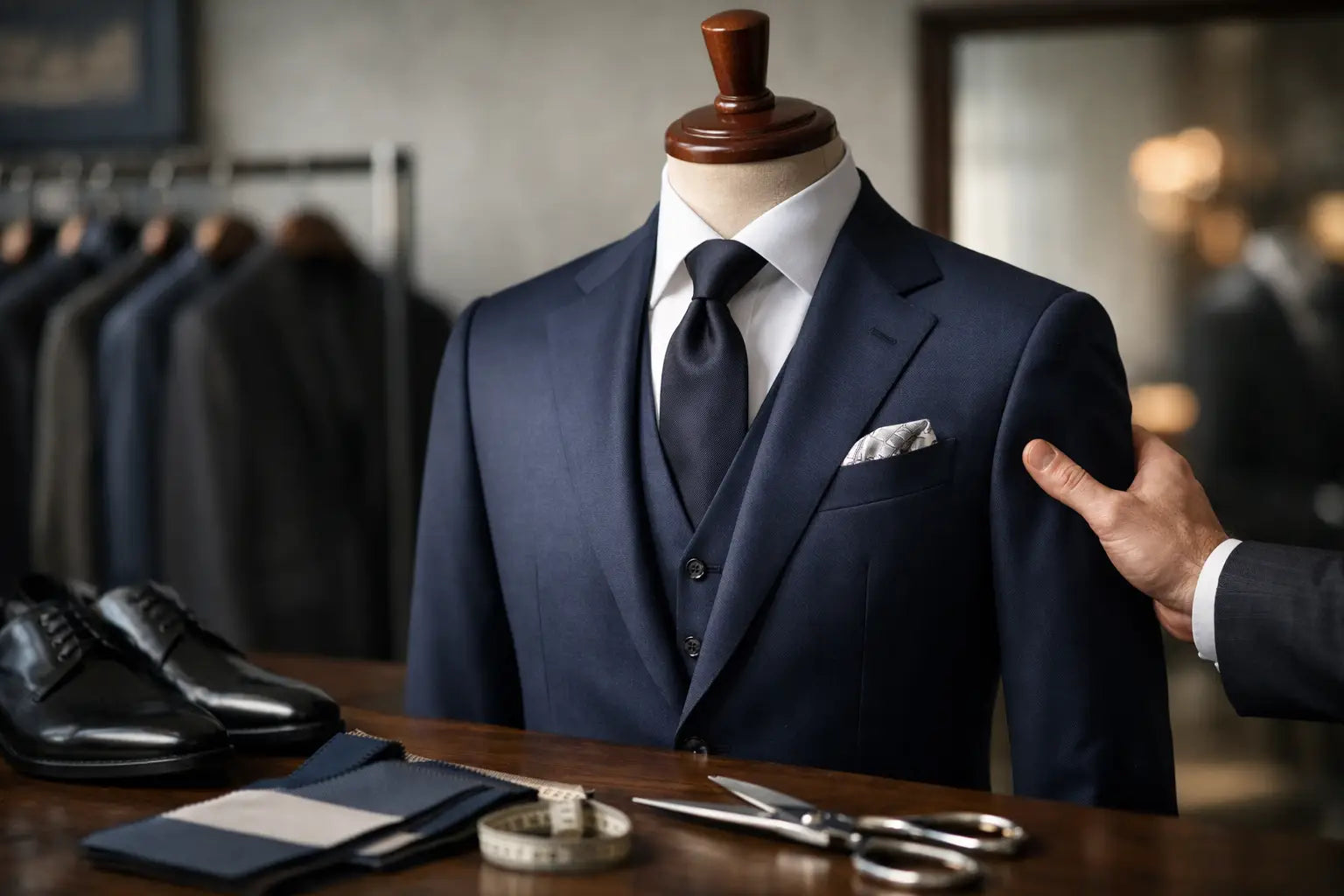
The result is not merely visual neatness. It is a suit that hangs correctly when you are standing, remains clean when you walk, and returns to shape when you sit and rise. Lapels sit with authority. The collar stays close to the neck. Trousers break with intention rather than collapse into excess cloth.
For a man who spends his time in boardrooms, at formal events, or under close social scrutiny, these details carry meaning. People may not identify the technical reason a suit looks exceptional, but they recognise the outcome immediately.
What you are really paying for
The cost of bespoke is often discussed too narrowly, as though the price rests on fabric alone. Cloth matters, of course, but it is only one part of the value.
You are paying for judgement. You are paying for a pattern drafted around your body and preserved for future commissions. You are paying for fittings that refine the garment in real time. You are paying for a level of handwork, precision and decision-making that cannot be replicated in volume production.
More than that, you are paying for alignment between garment and identity. A bespoke suit should not simply fit your frame. It should reflect how you need to appear in the world - sharper, quieter, more commanding, more elegant, more assured. That depends on profession, age, lifestyle and personal taste.
A founder meeting investors may need a different silhouette from a groom, even if both want navy cloth and peak lapels. One may require restraint and authority. The other may want formality with presence. Bespoke allows those distinctions to be expressed with precision.
The process behind the result
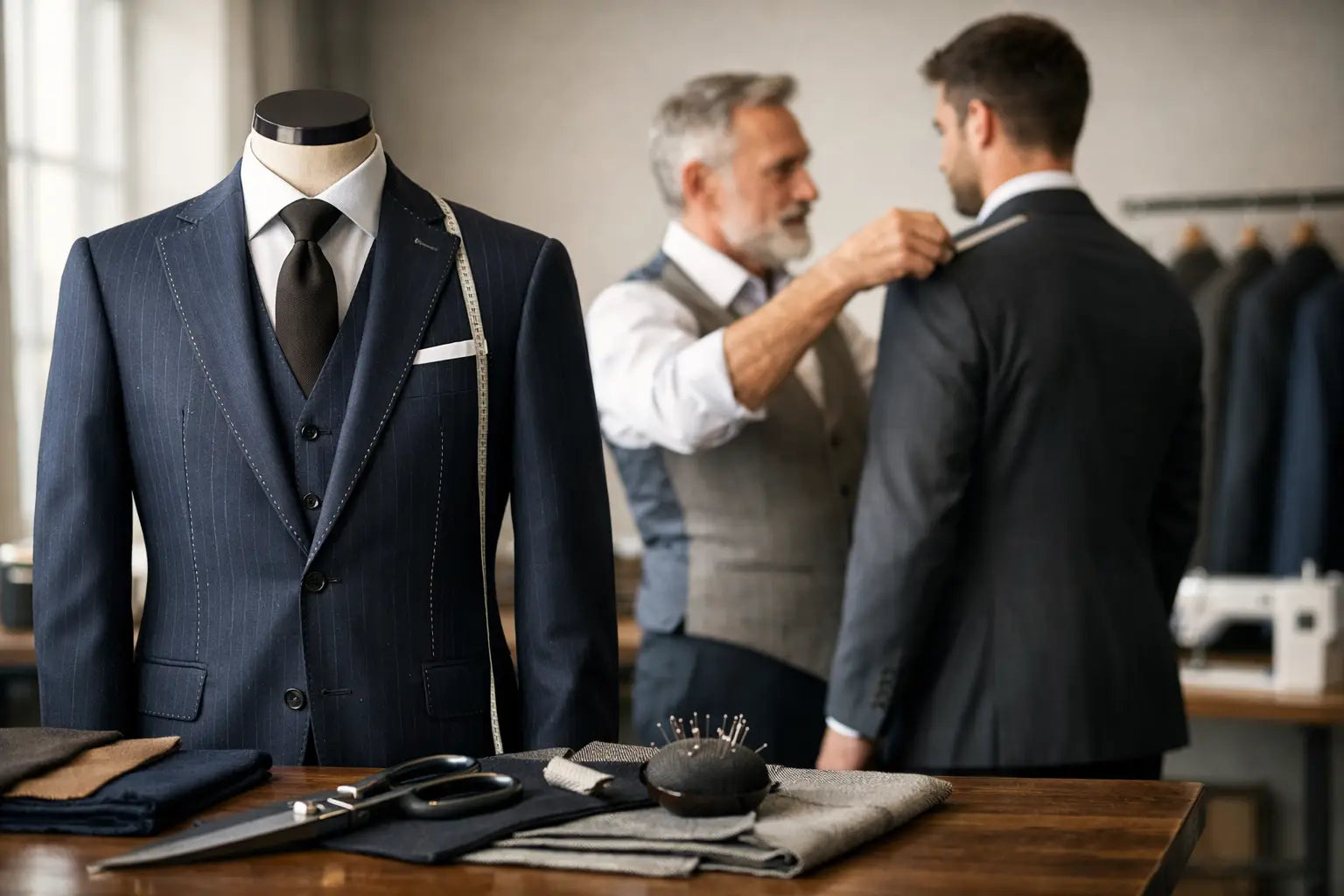
The art of bespoke is often appreciated most clearly through its process. It usually begins with a consultation, where the discussion extends beyond measurements. A capable tailor will want to understand where the suit will be worn, how often, in what climate, and how the client wishes to be perceived.
Fabric selection follows. This is not simply a question of colour. Weight, weave, drape and seasonal practicality all influence the final character of the garment. A cloth that performs beautifully in a London winter may feel unsuitable in a Gulf summer. A businessman who travels frequently may need resilience and ease. A ceremonial suit may prioritise richness of appearance over daily utility.
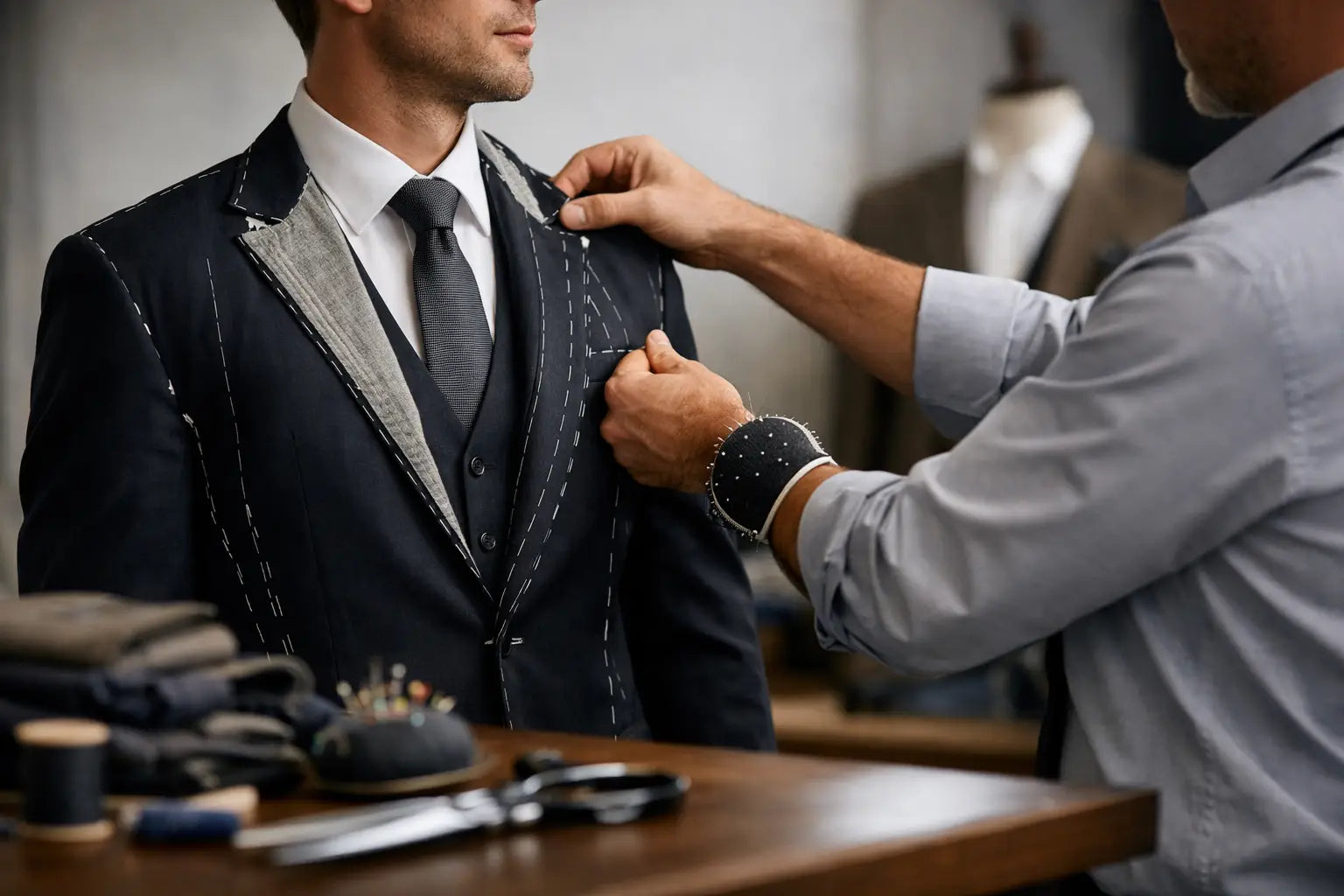
After measurements are taken, a personal pattern is drafted. The first fitting then reveals how theory meets reality. This stage is essential. Even the most experienced tailor uses fittings to perfect balance, line and comfort. Subsequent fittings sharpen those decisions until the suit settles naturally on the body.
That measured progression is one reason bespoke feels so different from ordinary shopping. It is controlled, intentional and deeply individual.
What bespoke is not
It is not instant. Men accustomed to immediate retail often underestimate this. A true bespoke suit takes time because refinement takes time. If speed is the only priority, bespoke may not be the right path.
It is also not about excess for its own sake. Bespoke is not defined by loud linings, aggressive details or obvious displays of expense. In fact, the finest bespoke garments are often the most restrained. Their authority comes from cut, balance and confidence rather than decoration.
Nor is bespoke automatically right for every wardrobe decision. If a client needs a straightforward travel suit quickly, a high-quality made-to-measure option may occasionally be sensible. The value of bespoke is greatest when fit is difficult to achieve, standards are high, or the garment has a meaningful role in a man's professional or social life.
That nuance matters. True luxury is not about insisting on the highest tier in every case. It is about knowing when precision will materially improve the result.
Why bespoke still matters now
In an age of convenience, bespoke remains relevant because modern success has made personal presentation more visible, not less. Rooms may be more informal than they once were, but scrutiny has not disappeared. If anything, it has become more immediate. People form judgements quickly, and clothing still shapes those judgements.
A bespoke suit communicates discipline, self-knowledge and discernment. Not because it is expensive, but because it looks resolved. Nothing appears accidental. The proportions feel considered. The wearer appears at ease in his own image.
For men who lead businesses, negotiate at a high level, attend important occasions, or simply refuse generic standards, that has practical value. In a place such as Dubai, where presentation often operates as a language of seriousness and stature, the difference between merely dressed and properly tailored becomes even more apparent.
This is why houses such as DONFIORITO place so much emphasis on consultation and fitting rather than treating tailoring as a transaction. The garment is only the visible outcome. The real craft lies in understanding the man first.
If you are still asking what is bespoke suits, the shortest answer is this: it is tailoring at its most personal, exact and intelligent. And once a suit is made with that level of attention, ordinary fit rarely feels enough again.
The best suit does not ask for attention. It settles the question of who you are before you speak.