Why Do Bespoke Suits Fit Better?
A suit can be expensive and still feel wrong within minutes. The collar lifts when you move, the trouser seat pulls when you sit, the jacket looks acceptable in the mirror yet somehow loses authority in the room. That is usually the moment clients ask, why do bespoke suits fit better? The answer is not simply that they are altered more carefully. A true bespoke suit is conceived for one body, one posture, one way of standing, walking and being seen.
Why do bespoke suits fit better than ready-to-wear?
Ready-to-wear is built on approximation. Even at the luxury end, a factory pattern begins with an assumed shoulder line, an assumed chest shape, an assumed stance and an assumed proportion between waist, seat and leg. The garment may then be adjusted, but its foundation remains generic.
Bespoke begins elsewhere. Instead of asking how a finished suit can be made acceptable, it asks how a suit should be built if the wearer is the starting point. That distinction changes everything. The chest can be shaped according to whether a man stands upright or slightly forward. The balance can be corrected for one shoulder that sits lower than the other. The jacket length can be judged not by fashion shorthand, but by what gives the wearer stature and composure.
This is why the fit feels different in practice, not just in theory. A bespoke suit does not merely cling more closely. It sits with more intelligence on the body.
The pattern is unique to the wearer
The single greatest reason why bespoke suits fit better is the pattern itself. In bespoke tailoring, the cutter creates an individual paper pattern for the client rather than modifying a standard block. That pattern records the client’s architecture in a far more precise way than chest size and trouser waist ever could.
Measurements matter, of course, but measurement alone is not enough. Two men can share the same numerical size and require entirely different jackets. One may have a prominent shoulder blade, another a fuller chest, another a forward neck, another a straighter seat. If all are placed into the same underlying pattern, one or more areas will always resist the body.
With bespoke, those nuances are observed from the outset. The pattern is drafted to account for asymmetry, posture and proportion. That is where superior fit begins - not at the final fitting, but at the first line drawn.
Fit is about balance, not tightness
Many men confuse fit with closeness. A jacket can be slim and still fit poorly. Equally, a fuller cut can fit beautifully if the balance is correct. Bespoke tailoring understands this distinction.
Balance refers to how the garment hangs on the body from neck to hem, front to back and side to side. If the front skirt kicks away, if the collar gapes, if the hem tilts, the problem is rarely solved by taking something in. It is usually a balance issue. Bespoke allows the cutter to correct that balance through pattern work and fittings, so the coat falls cleanly and the wearer appears composed rather than constrained.
Why posture changes everything
Most off-the-peg clothing assumes a fairly standard posture. Very few successful men have one. Long hours at a desk, frequent travel, athletic training, old injuries and simple physical individuality all leave their mark on how a jacket must be built.
A man with a slightly forward head position will often struggle with collar fit in ready-made tailoring. Someone with one shoulder marginally lower than the other may find one sleeve breaks badly while the other appears acceptable. A prominent seat may require more length and shape through the back trouser rise, while a flatter seat may need less cloth and a different angle.
These are not flaws. They are simply realities of the body. Bespoke tailoring treats them with respect rather than pretending they do not exist. The result is a suit that moves with greater ease because it was built entirely around the body it belongs to.
The fitting process refines what measurements cannot
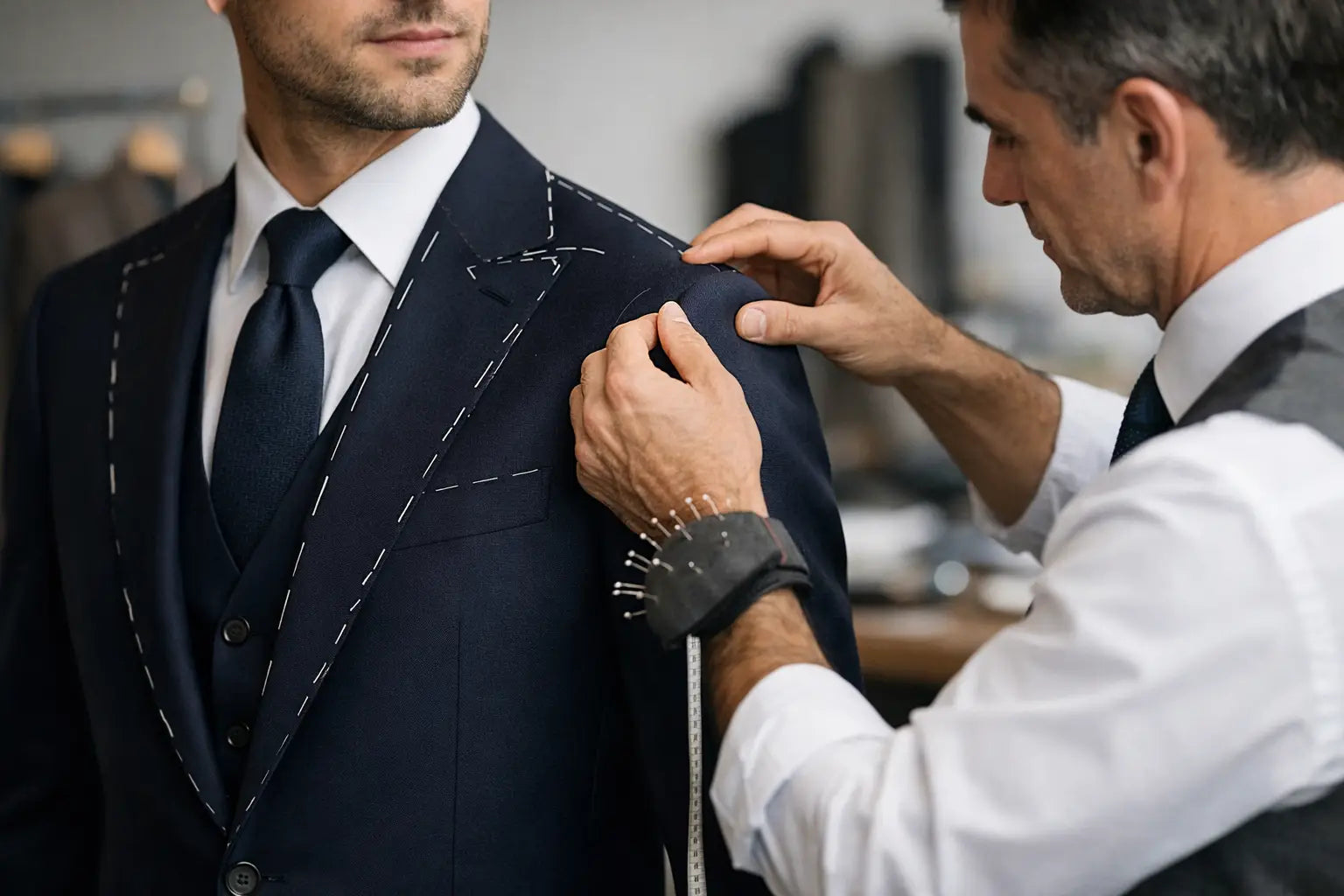
If measurements establish the foundation, fittings bring the suit to life. This is another answer to why bespoke suits fit better: there is room for observation, correction and refinement at several stages.
At the first fitting, the tailor studies how the cloth behaves when worn. Does the chest sit cleanly? Is there strain across the buttoning point? Does the sleeve pitch suit the natural arm position? Is the trouser line elegant when standing and comfortable when seated? These things cannot be fully known on a tape measure alone.
A second or subsequent fitting allows further precision. Minor corrections in the sleeve, waist suppression, seat shape or trouser break can transform a suit from good to exceptional. What matters is not perfection for its own sake, but coherence. Every element begins to work together.
This process also explains why bespoke is not the right choice for every purchase. If a client needs a suit tomorrow, ready-to-wear with skilled alterations may be the practical solution. Bespoke rewards patience. It is for the man who values the end result enough to allow the garment to be developed properly.
Comfort is a sign of precision
A well-fitted bespoke suit often surprises first-time clients because it feels easier to wear than many casual garments they own. That may seem counterintuitive until one understands what comfort in tailoring actually means.
Comfort does not come from excess fabric or loose construction. It comes from having room where the body needs motion and clean control where the silhouette needs definition. The armhole may be cut higher to allow freer movement. The chest can be shaped to avoid collapse without pressing against the ribcage. Trousers can sit correctly on the waist so they do not shift throughout the day.
When this is done properly, the wearer stops adjusting himself. He does not tug at cuffs, pull down the jacket front or loosen his waistband after lunch. The suit remains settled. That calm is one of the clearest marks of quality.
Better fit also means better presence
There is a practical reason successful men invest in bespoke, and it is not vanity. Fit influences presence. It affects the way others read authority, discretion and self-command.
A jacket that frames the shoulders correctly creates poise. Trousers that fall cleanly lengthen the leg line. A coat that sits close without tension suggests confidence rather than effort. None of this needs to be theatrical. In fact, the best bespoke suits are often admired without announcing why they look superior.
For professionals who move between boardrooms, private meetings and formal occasions, this matters. Clothing is part of communication. A bespoke suit does not replace judgement or character, but it does ensure appearance supports them rather than distracting from them.
Why alterations are not the same as bespoke
A common question is whether a very good off-the-peg suit, heavily altered, can achieve the same effect. Sometimes it can come close for certain bodies. But there are limits.
Alterations can shorten sleeves, suppress the waist, adjust trouser hems and refine some areas of the seat or jacket body. They cannot easily change the original shoulder architecture, armhole position, chest balance or the fundamental relationship between front and back. If the base pattern is wrong, the finished result will usually remain a compromise.
That compromise may be perfectly reasonable depending on the occasion, budget and timescale. Bespoke simply removes more of those structural limitations.
Why cloth and construction matter to fit
Fit is not only a matter of pattern. Cloth, canvas and construction influence how a suit settles over time. A superior bespoke garment is shaped internally as well as externally, allowing it to mould to the wearer with use.
A well-chosen fabric drapes according to the client’s needs. A businessman who spends much of the day seated may require a cloth with resilience and recovery. Someone dressing for evening may prioritise fluidity and elegance. The internal structure of the jacket then supports that cloth so it holds line without looking stiff.
This is another subtle difference between bespoke and standard suiting. The aim is not simply to produce a suit that fits on the day of collection, but one that continues to wear well and retain its character.
Why do bespoke suits fit better for some men than others?
The honest answer is that the benefit is most dramatic when the wearer rarely fits standard sizing well. Men with strong athletic builds, asymmetrical shoulders, unusual proportions or exacting standards usually notice the difference immediately.
But even men who can buy ready-made clothing with relative ease often choose bespoke for a different reason. They want precision, not adequacy. They want a silhouette that reflects who they are and how they wish to be perceived. In a place such as Dubai, where presentation often carries commercial and social weight, that distinction is not superficial. It is strategic.
The finest bespoke tailoring does not force a man into an idealised shape. It clarifies his own. That is why the fit feels more convincing, why the garment becomes easier to wear, and why confidence arrives without performance. When a suit is made with true regard for the person inside it, the result is not simply better fitting clothing. It is a more exact expression of presence.