Bespoke or Made-to-Measure?
A suit can look expensive and still feel slightly wrong the moment you move. The shoulder sits a fraction too wide, the collar lifts when you turn, the waist behaves well enough when standing still and then loses its line by lunchtime. This is where the question of bespoke or made-to-measure becomes more than terminology. It becomes a question of how a garment is expected to serve the man wearing it.
For clients who rely on personal presence, the distinction matters. A suit is not simply cloth cut into a familiar shape. It is a statement of proportion, discipline and judgement. When the fit is precise, people may not identify every technical reason, but they recognise the effect immediately.
Bespoke or made-to-measure: what is the difference?
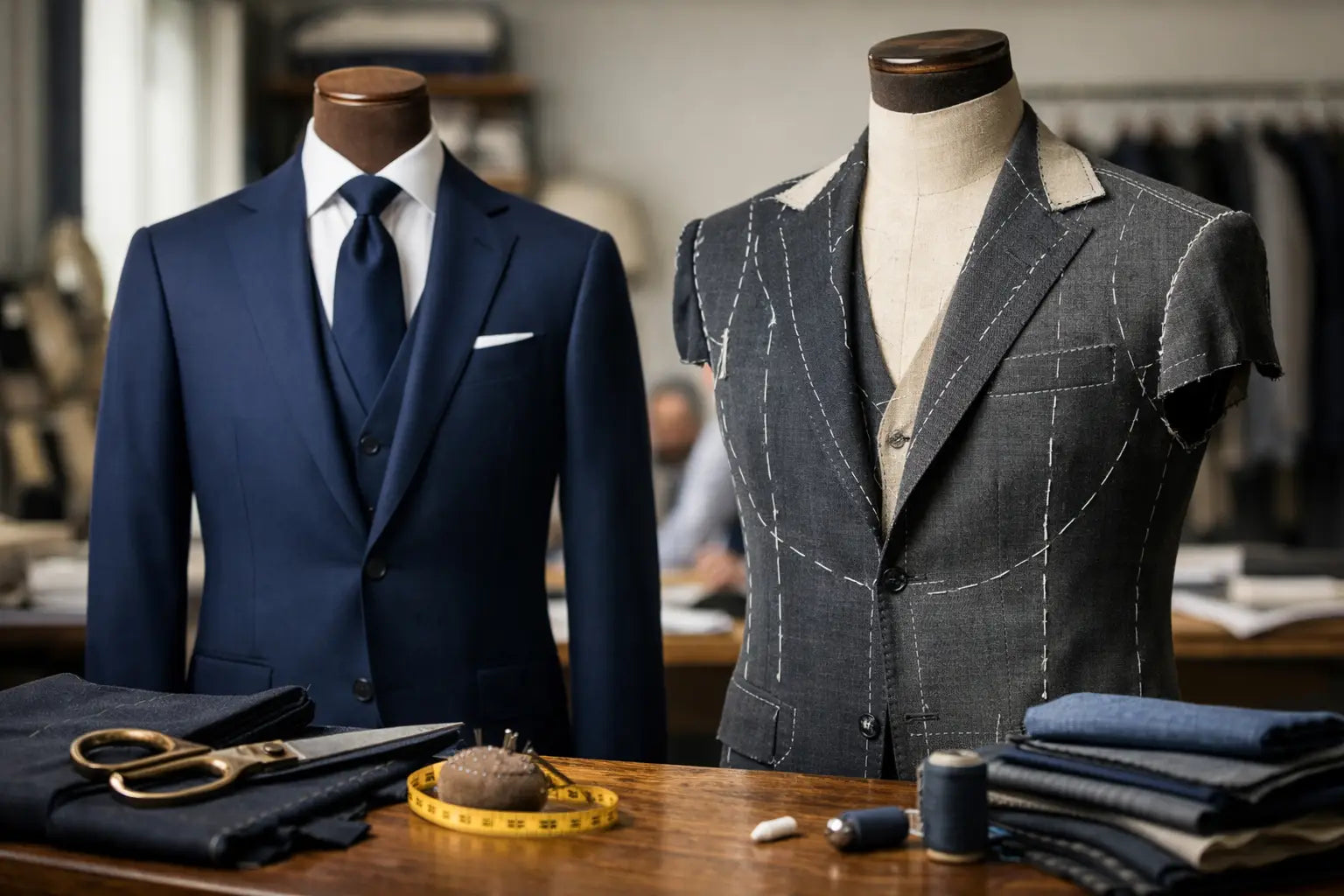
The simplest distinction is this: made-to-measure begins with an existing base pattern, while bespoke begins with a pattern drafted specifically for one individual. That difference affects everything that follows - the fit, the balance, the comfort and the character of the finished garment.
Made-to-measure is, at its best, a refined version of standard sizing. Measurements are taken, a pre-existing block is adjusted, and certain style options are selected. It can improve on ready-to-wear significantly, particularly for men whose proportions sit close to conventional sizing. For some wardrobes and some schedules, it is a sensible solution.
Bespoke is a different discipline. The garment is built entirely around the body it belongs to. The pattern does not assume symmetry where none exists, nor does it force the client into a standardised silhouette. It responds to posture, shoulder expression, stance, arm position and the subtle physical realities that mass production has no reason to honour.
This is why the two should not be treated as interchangeable. Both may produce a custom-looking suit, but only one is created from first principles around the individual man.
Why the pattern matters more than most men realise
Luxury cloth and elegant finishing attract attention, but pattern making determines whether the suit has authority. A handsome fabric cannot rescue poor balance. If the chest is overstrained, the sleeve pitch is wrong, or the coat collapses at the back, the garment will never carry itself properly.
In made-to-measure, the pattern already exists before the client arrives. The tailor or brand alters what is already there. This can work well when the wearer needs moderate correction rather than genuine reconstruction. If a man has relatively standard shoulders, a balanced posture and predictable proportions, made-to-measure may produce a respectable result.
But many successful clients are not dressing for respectable. They are dressing for precision. They want the clean drape of a coat that remains composed from boardroom to dinner, and trousers that sit correctly without constant adjustment. They want to feel that the suit belongs to them, not that they have been fitted into a system.
Bespoke allows for this because the pattern records the individual rather than approximating him. One shoulder may sit lower. The chest may be fuller on one side. The right arm may rotate differently from the left. A businessman who spends long hours travelling, sitting in meetings and moving between formal and private settings does not need a suit that behaves well only when he is standing still in front of a mirror.
Fit is not just tightness or looseness
Many men think fit means whether a garment is slim or relaxed. That is only a small part of it. True fit concerns balance, movement and proportion. The collar should sit cleanly against the neck. The lapel should break with confidence. The coat should follow the body without pulling from the button point or ballooning at the back.
This is where bespoke earns its reputation. It accounts for how the body exists in motion and at rest. A well-cut bespoke suit feels calm. It does not ask for constant correction. It allows the wearer to focus on the room, the conversation and the impression being made.
When made-to-measure is enough
There is no value in pretending made-to-measure has no place. It does. A man building a broader wardrobe may choose it for less critical garments. Someone with time constraints may prefer a shorter process. It can also be appropriate for clients who know their preferences clearly and whose proportions are relatively easy to fit.
At the higher end of the market, good made-to-measure can offer elegant cloth, tasteful design options and a cleaner outcome than off-the-peg tailoring. For travel suits, occasional business wear or men at the beginning of their custom clothing journey, it may be a practical starting point.
The limitation appears when expectations rise. If the client is highly particular about silhouette, has noticeable fitting challenges, or wants a garment that projects a very specific image, made-to-measure often reaches its natural ceiling. Adjusting a house block can only go so far before the garment begins to resist the wearer rather than serve him.
When bespoke becomes the right decision
Bespoke is right when the suit has work to do beyond clothing the body. If your wardrobe is part of your professional language, if first impressions carry commercial weight, or if standard tailoring has repeatedly disappointed you, bespoke is not indulgence. It is clarity.
For executives, entrepreneurs and public-facing professionals, small visual errors are rarely small. An overlong jacket shortens the leg line. Suppressed waisting placed too high can make the coat feel artificial. Sleeves set without regard for natural stance can spoil the entire posture of a suit. Bespoke addresses these points with intention.
It also gives more control over the garment’s expression. Not simply peak or notch lapels, but how the coat frames the torso, where it draws the eye, how much structure the shoulder should carry, how soft or assertive the line should appear. This is the difference between choosing details and shaping identity.
The process itself changes the result
A true bespoke experience unfolds through consultation, cloth selection, fittings and refinement. Each stage has a purpose. The consultation is not merely administrative. It establishes how the client wishes to be perceived, how he lives in his clothes, and where previous tailoring has failed him.
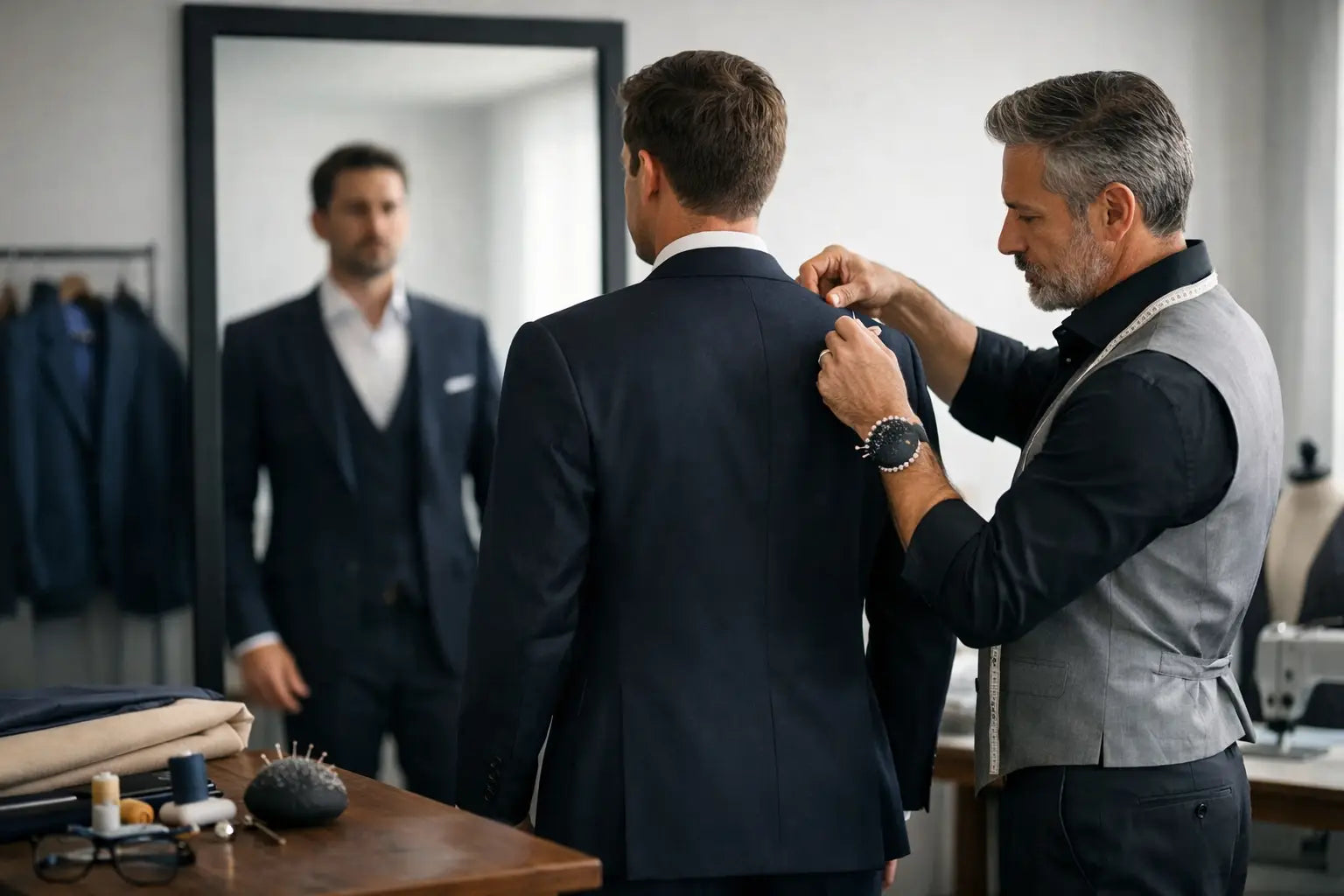
The first fitting reveals what measurements alone cannot. The garment begins to communicate. Balance is assessed. Suppression is reconsidered. Lengths, drape and line are refined in relation to the wearer rather than to theory. Additional fittings bring the suit closer to that rare point where precision and ease become one and the same.
This measured approach is especially valuable in a city such as Dubai, where men often require wardrobes that move effortlessly between business, formal engagements and private social settings. Presence must remain intact across environments, and comfort cannot be sacrificed to appearance.
Bespoke or made-to-measure for value
Price is often treated as the deciding factor, but value is the more intelligent measure. A made-to-measure suit that never feels entirely correct is expensive, no matter the invoice. A bespoke suit worn repeatedly with confidence, comfort and consistency can prove the better investment.
The real question is not what costs less at the start. It is what delivers the result you expect. If your standard for tailoring is simply to look presentable, made-to-measure may satisfy it. If your standard is to look composed, distinguished and unmistakably well dressed, bespoke justifies its place.
There is also the matter of longevity in style, not only in construction. Bespoke tends to age more gracefully because it is less dependent on generic fashion proportions. It reflects the wearer’s own architecture. That gives it a steadier elegance over time.
The choice should reflect the man, not the label
Some men are drawn to the word bespoke because it carries prestige. Others dismiss it as unnecessary before they have understood what it offers. Neither instinct is especially useful. The better approach is to ask what your wardrobe requires of you and whether your current tailoring truly meets that standard.
If you are dressing for convenience, made-to-measure may be sufficient. If you are dressing for authority, nuance and exacting fit, bespoke becomes difficult to replace. The difference is not only visible in the mirror. It is felt in posture, in ease, and in the quiet certainty that the garment is performing exactly as it should.
At DONFIORITO, that distinction is treated with the seriousness it deserves. Not because one method needs dramatic marketing, but because a man investing in his image should understand precisely what he is paying for.
The best choice is rarely the one with the louder name. It is the one that leaves nothing unresolved once the suit is on.