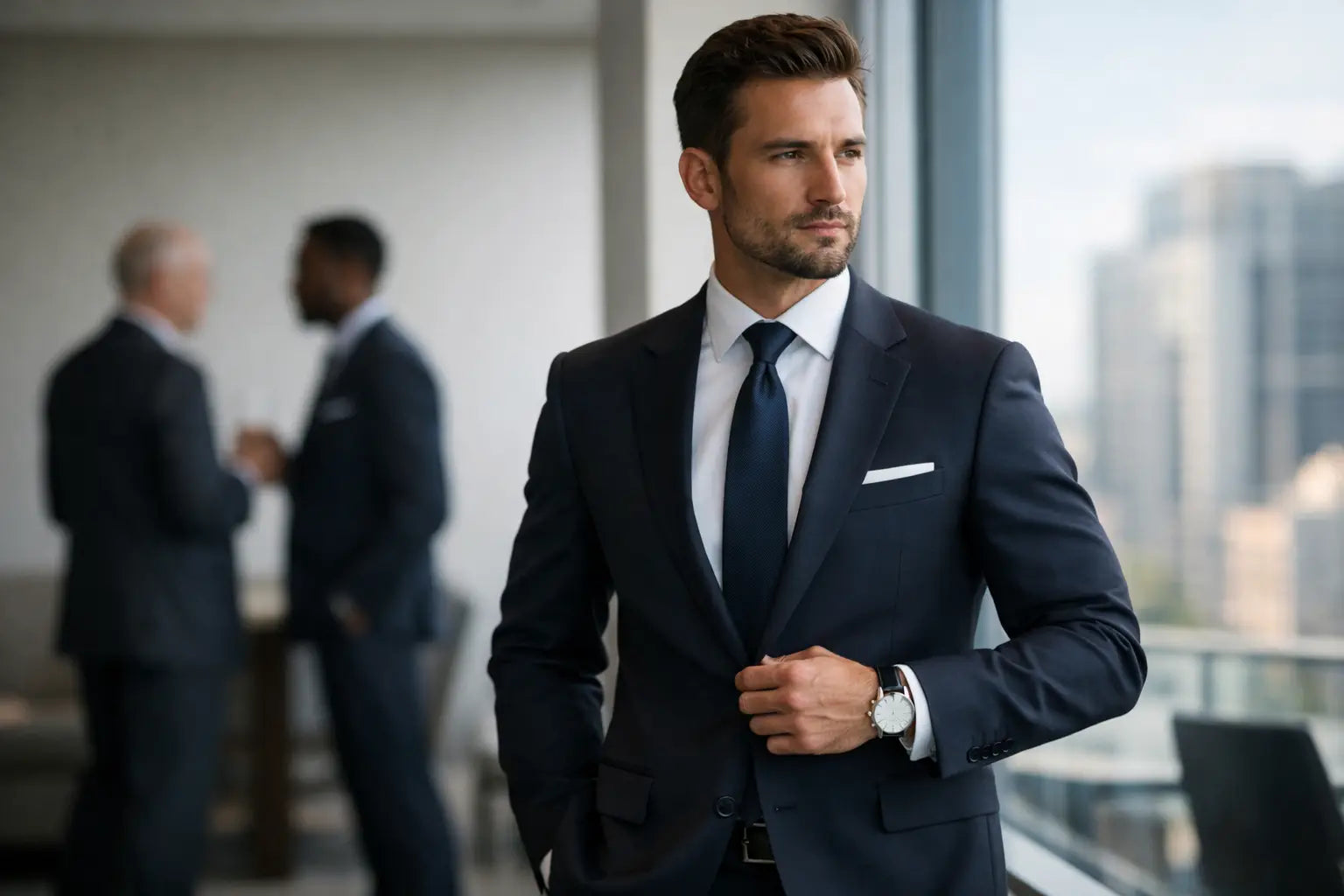
Power Dressing for Men That Actually Works
A man is often assessed before he has spoken a full sentence. In the boardroom, at a private dinner, during a negotiation or an introduction, clothing begins the conversation early. That is why power dressing for men has never been about flamboyance or fashion theatre. It is about control - of silhouette, of proportion, of message, and of the impression that remains once the room has moved on.
The phrase has been flattened over the years into clichés about sharp suits and expensive watches. The truth is more exacting. Real authority in dress comes from precision, not decoration. It comes from knowing how a garment should frame the body, how colour should support complexion and setting, and how restraint often communicates more than display.
What power dressing for men really means
At its best, power dressing for men is the disciplined use of clothing to express credibility, self-possession and intent. It signals that the wearer understands context and respects it, but is not governed by it. There is confidence in that balance.
This is why the most effective examples are rarely the loudest. A suit with a clean shoulder line, a strong drape through the chest, and a trouser that breaks correctly over the shoe will carry more weight than any overstated logo or trend-led flourish. Power is perceived in coherence. Every element should feel considered, and nothing should appear to be trying too hard.
There is also a distinction between dressing to impress and dressing with authority. The first seeks approval. The second projects assurance. One is outwardly anxious, the other inwardly settled. Experienced men understand the difference instinctively, even if they have never articulated it.
Why fit matters more than expense
Luxury without fit is merely cost. A superior cloth cut to the wrong balance still weakens the silhouette, and a prestigious label cannot rescue a jacket that collapses at the collar or strains across the buttoning point.
The most important quality in a powerful wardrobe is that each garment appears built for the man wearing it. The shoulder should sit cleanly. The chest should feel generous without excess. The waist should be shaped enough to suggest structure, not vanity. Sleeves and trousers should finish with intent, not approximation.
A well-cut jacket changes posture. It encourages the body to carry itself properly and gives the wearer a natural sense of composure. That is not a minor detail. The finest tailoring does not simply cover the body. It improves how the body is presented.
Off-the-rack garments can be serviceable, but they are designed around average assumptions. Authority is rarely communicated through average assumptions. Bespoke tailoring, by contrast, begins with the individual - his frame, his movement, his preferences, and the way he wishes to be perceived. That difference is visible long before anyone notices the cloth.
The foundation of a powerful wardrobe
A powerful wardrobe does not need to be large. It needs to be exact. For most men, the starting point is a dark navy suit and a charcoal suit, both cut with enough distinction to stand apart from standard businesswear. Navy offers depth and flexibility. Charcoal carries a slightly more formal, authoritative tone. Together, they cover most professional requirements with quiet force.
Shirts should support the jacket rather than compete with it. Crisp white remains unmatched for clarity and contrast, while pale blue introduces ease without diminishing seriousness. The collar matters more than many men realise. It frames the face, determines how the tie sits, and affects the entire line of the upper body.
Ties deserve similar discipline. Power does not reside in novelty prints or exaggerated shine. A silk tie in grenadine, fine twill or a subtle weave speaks with greater maturity. Burgundy, navy, deep green and restrained patterns tend to hold their ground well in formal and business settings.
Shoes complete the argument. Poor shoes can dismantle an otherwise convincing look with remarkable efficiency. Black Oxfords remain the clearest expression of formality and discipline. Dark brown can be equally effective in many business environments, particularly when paired with navy or textured tailoring. What matters is condition. Scuffed shoes suggest neglect, and neglect has no place in power dressing.
Colour, cloth and the language of authority
Men often overestimate the role of novelty and underestimate the role of surface. The texture of a cloth, the density of its weave, and the way it catches light all influence how a suit is read.
A high-twist wool in deep navy has a dry, crisp authority suited to warm climates and long business days. A finer worsted in charcoal offers smooth elegance for formal settings. A flannel suit introduces quiet depth, but it depends on season and setting. Cloth should always be chosen in relation to use, not fantasy.
Colour should be equally intentional. Darker tones generally communicate command because they create visual gravity. That does not mean black should dominate the business wardrobe. In many professional contexts, black can feel severe or ceremonial. Navy, charcoal and mid-grey are more versatile and often more sophisticated.
There is room, of course, for personality. A subtle windowpane, a rich chocolate jacket, or a muted pinstripe can all be highly effective. The question is whether they reinforce the wearer or distract from him. When in doubt, refinement is the safer expression of confidence.
The details that separate presence from costume
Powerful dress is won or lost in the details. Not because detail should dominate, but because inconsistency is instantly visible.
A pocket square should add polish, not performance. A watch should feel proportionate to the wrist and appropriate to the setting. Belt, shoes and metal tones should not clash carelessly. Trousers should sit at the correct height so the jacket and shirt relate cleanly.
Even the break of the trouser carries meaning. Too much fabric pooling over the shoe looks indecisive. Too little can appear affected unless the rest of the silhouette supports it. Likewise, lapel width should relate to the wearer’s build. These are not arbitrary rules. They are questions of visual balance.
This is where many men go wrong with so-called power dressing. They assemble symbols of status without understanding proportion. The result can feel theatrical rather than assured. Genuine elegance has no need to announce itself loudly.
Power dressing for men in different settings
Context changes the expression of authority. A man leading a finance meeting, attending a wedding, hosting a private gathering or travelling between appointments will not be best served by one uniform approach.
In a formal business setting, structure matters. A well-defined shoulder, a darker palette and a considered tie create the right degree of gravity. In more entrepreneurial or creative environments, authority may be better expressed through a softer jacket, open collar and richer fabric texture. The point is not to relax standards. It is to align the wardrobe with the occasion while maintaining polish.
Climate also plays a role. In warmer regions such as Dubai, power dressing must account for temperature without surrendering shape. Lightweight wools, open weaves and intelligent construction allow the suit to remain elegant and composed rather than heavy or fatigued. A man should look as collected at midday as he does when he first leaves the house.
Evening has its own register. Here, depth becomes more important than overt formality. Midnight blue, black tie elements, a superior dinner jacket or an impeccably cut dark suit can project social confidence with far greater sophistication than anything overly embellished.
Why bespoke remains the highest expression of power
A powerful wardrobe should not merely fit your body. It should fit your life, your pace and your standards. That is the advantage of bespoke. It allows every decision - cut, cloth, lining, collar, button stance, trouser shape - to be made in service of the individual rather than adjusted from a generic starting point.
For a man whose image carries professional and social consequence, this is not indulgence. It is precision. A bespoke garment is built entirely around the body it belongs to, but also around the impression it is meant to create. That level of control is the real luxury.
At DONFIORITO, that principle sits at the centre of the process. Consultation, fitting and final refinement are not ornamental stages. They are how a suit acquires its authority. The end result is not simply a better garment. It is a clearer expression of the man wearing it.
Power dressing, then, is less about dressing up than dressing exactly right. When the cut is intelligent, the cloth is appropriate and the silhouette is unmistakably your own, authority no longer needs to be performed. It is simply present.