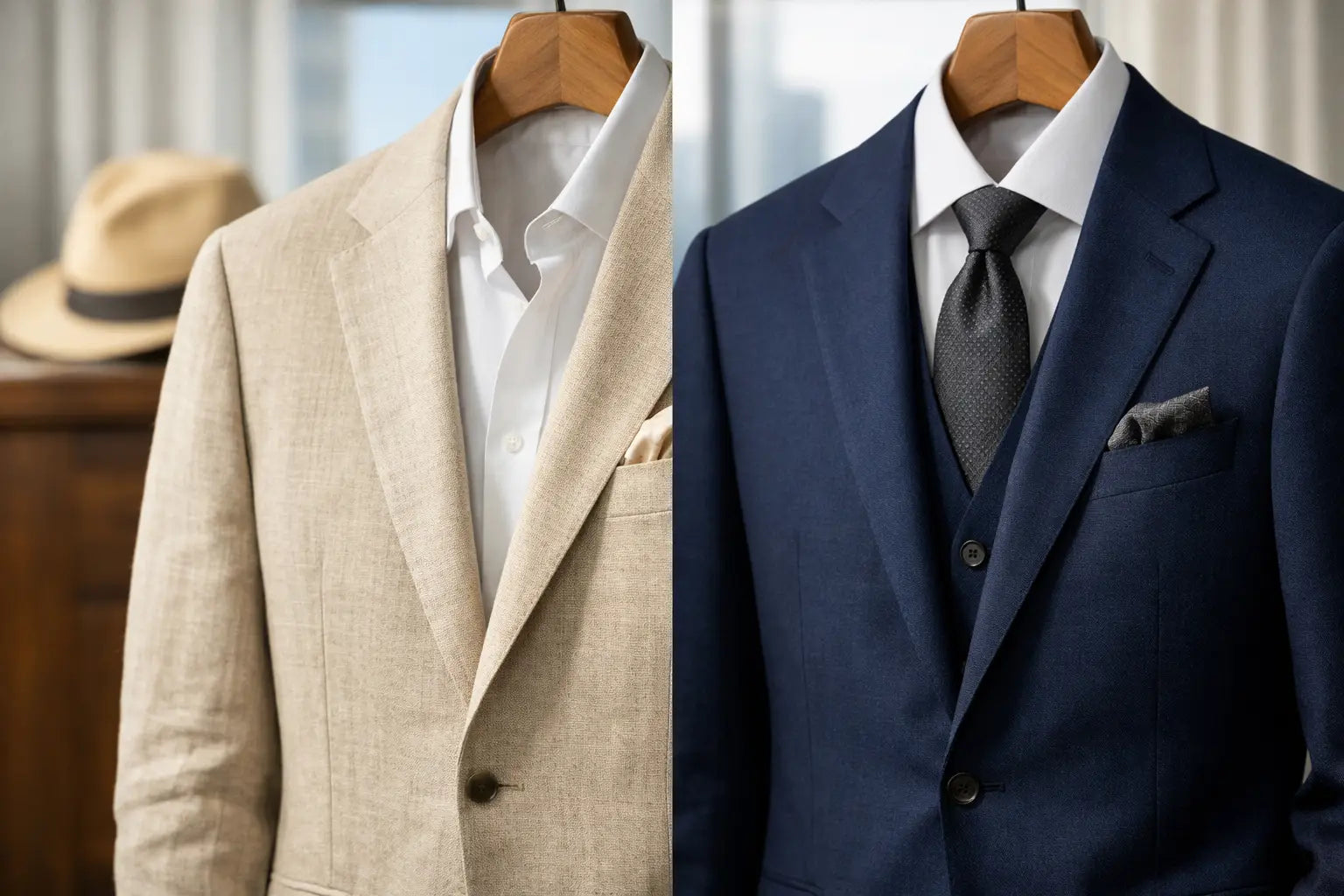
Linen Suit Versus Wool Suit: Which Is Right?
A suit can be impeccably cut and still feel wrong if its cloth is chosen without regard for the occasion, climate and the impression it must create. The question of a linen suit versus wool suit is therefore not simply seasonal. It is a decision about how you move through the day, how formal the room will be, and whether you want crisp composure or relaxed distinction.
For a client in Dubai, the answer is rarely absolute. A summer luncheon, a destination wedding, a board presentation and an evening reception ask different things of a garment. The finest choice is the one built around your calendar, your body and the manner in which you wish to be remembered.
Linen Suit Versus Wool Suit: The Essential Difference
Linen is a natural bast fibre with a dry, open character. It feels light against the skin, allows air to circulate and has an unmistakable texture that gives a suit visual ease. It is at its best when warmth is part of the setting rather than an inconvenience to be concealed.
Wool, particularly fine worsted wool, is more adaptable than many men expect. Its fibres regulate temperature remarkably well, its surface can be smooth and refined, and its natural resilience helps the cloth recover after sitting, travelling or a long day of meetings. In bespoke tailoring, wool offers a wider range of weights, weaves and finishes, allowing the garment to retain an elegant line across more occasions.
The distinction is visible before it is felt. Linen has a matte, gently irregular surface that suggests confidence without ceremony. Wool can range from understated and businesslike to richly expressive, but it usually presents a cleaner, more controlled silhouette. Neither is superior in every circumstance. The question is whether the suit should look deliberately relaxed or impeccably composed.
When Linen Makes the Stronger Choice
A linen suit belongs to bright days, outdoor events and settings where formality should feel effortless. In pale stone, tobacco, soft blue or muted olive, it has an ease that conventional dark suiting cannot replicate. It is particularly compelling for daytime celebrations, resort travel and summer social occasions where a polished appearance is expected but stiffness would feel out of place.
The principal advantage is comfort in heat. Linen absorbs moisture well and releases it quickly, helping the wearer feel cooler during long outdoor periods. A carefully considered bespoke cut enhances this quality: a lighter canvas, thoughtful lining choices and enough room through the chest and seat prevent the suit from feeling restrictive.
Its characteristic creasing deserves an honest assessment. Linen will crease. This is not a defect, nor is it something a tailor can entirely engineer away. A beautifully made linen suit develops a lived-in texture as the day progresses, and that is part of its appeal. Yet it is not the right choice for every man or every engagement. If you need to step from a car into a formal meeting looking as crisp at 6pm as you did at 8am, pure linen may ask too much of the cloth.
For this reason, linen suits reward a certain confidence. They communicate that the wearer understands the dress code well enough not to overstate it. The suit should be fitted with precision, but never pulled tight. Linen needs a little generosity to drape naturally and to retain its elegant nonchalance.
Linen is not only for holidays
The association between linen and leisure is understandable, but incomplete. In the right shade and with an appropriately refined shirt, linen can work beautifully for business lunches, private client appointments and less formal daytime gatherings. A deep navy or charcoal-toned linen suit, for example, carries more authority than a pale beige version while retaining the fabric's breathable character.
What matters is the wider composition. Avoid treating linen as an excuse for carelessness. Clean proportions, a considered collar, fine footwear and a shirt with restraint keep the look elevated. The effect should be relaxed, never casual.
Why Wool Remains the Foundation of a Serious Wardrobe
A wool suit is the more versatile investment for a man whose diary moves between formal business, travel and evening engagements. Fine wool has an authority that is difficult to imitate. It holds its shape, takes a sharp press and provides a level of visual depth that makes even a simple navy or charcoal suit appear intentional.
For executives and entrepreneurs, this matters. A suit often enters the room before its wearer speaks. The clean drape of wool communicates readiness and self-command, especially in environments where trust, discretion and judgement are being assessed within minutes.
Wool also performs more effectively across changing temperatures than its reputation suggests. A lightweight tropical wool or high-twist wool is breathable, dry to the touch and well suited to warm climates when the garment is cut and constructed correctly. It may not feel as airy as linen in peak outdoor heat, but it will generally look more composed after a full day.
High-twist wool is especially valuable for frequent travellers and men with demanding schedules. Its springy fibres resist creasing, making it a reliable choice for long flights, consecutive meetings and garments that need to recover quickly. The cloth has enough structure to maintain a strong silhouette, yet can be selected in weights that remain comfortable in Dubai for much of the year.
Wool offers greater formal range
Where linen excels in atmosphere, wool excels in range. A medium-weight wool suit can serve a presentation, a dinner, a wedding or an important negotiation with a simple change of shirt, tie and shoes. Darker wools bring gravity; mid-blue and grey offer daily versatility; lighter cloths can feel appropriately seasonal without losing sophistication.
This is why a first bespoke suit is so often made in a refined navy or charcoal wool. It gives the wearer a dependable foundation, built entirely around the body it belongs to. The lapel roll, shoulder expression, trouser line and balance of the jacket can all be calibrated to create a presence that off-the-rack clothing rarely achieves.
The Role of Cut and Construction
Fabric alone does not determine comfort. A poorly cut linen suit can feel cumbersome, while a well-made lightweight wool suit can remain remarkably comfortable in warm conditions. Bespoke tailoring begins with the wearer: posture, shoulder slope, chest shape, stance and the way the body moves all influence how a cloth should be handled.
Linen often benefits from a softer construction. Reduced padding and a lighter internal structure preserve its natural movement. The result is a jacket that feels less imposed upon the body and more like an extension of it. However, softness must still be controlled. The collar must sit correctly, the chest must retain balance and the front must not collapse.
Wool permits more architectural expression. A tailor can create a cleaner shoulder, sharper lapel and more defined waist suppression without fighting the cloth. This makes wool especially suited to men who want a powerful, sculpted silhouette. Yet the cut should never become theatrical. True presence comes from proportion and ease, not from excessive tightness.
At DONFIORITO, the conversation is not limited to whether you prefer linen or wool. It considers where the suit will be worn, how often you travel, whether you run warm, and what your clothing should communicate before a word is exchanged.
A Third Option: Linen-Wool Blends
For many clients, the most intelligent answer sits between the two. A linen-wool blend combines linen's dry texture and breathable feeling with wool's resilience and shape retention. It will still carry some of linen's natural character, but usually with fewer pronounced creases and a more controlled drape.
This makes it a compelling option for daytime business events, warm-weather weddings and travel where the dress code is elevated. The blend does not erase the identity of either fibre. Instead, it moderates their extremes. You gain a cloth that looks lighter and more expressive than conventional wool, while remaining more dependable than pure linen through a demanding day.
The exact blend matters. Some are predominantly wool with a touch of linen for texture; others lean more heavily towards linen for a visibly summery finish. During a private consultation, handling the cloth in person is essential. Colour, weight and texture cannot be fully judged from a screen, particularly when the objective is a garment of lasting relevance.
Choosing for the Occasion, Not the Label
Choose linen when the occasion is daytime, warm, social or destination-led, and when a little natural creasing will complement the atmosphere. Choose wool when you require authority, repeat versatility and a suit that remains polished from first meeting to final reservation. Choose a blend when your life frequently asks for both.
Consider the message as carefully as the temperature. A cream linen suit at an outdoor wedding can be exactingly elegant. The same suit in a formal financial meeting may feel disconnected from the room. Equally, a dark wool suit can command respect in a boardroom yet appear unnecessarily severe at a sunlit celebration.
The most distinguished wardrobe does not attempt to make one fabric perform every role. It contains purposeful garments, each cut with conviction and selected for the moments that matter. When cloth, construction and personal presence are aligned, the suit stops being something you wear and becomes part of how you arrive.