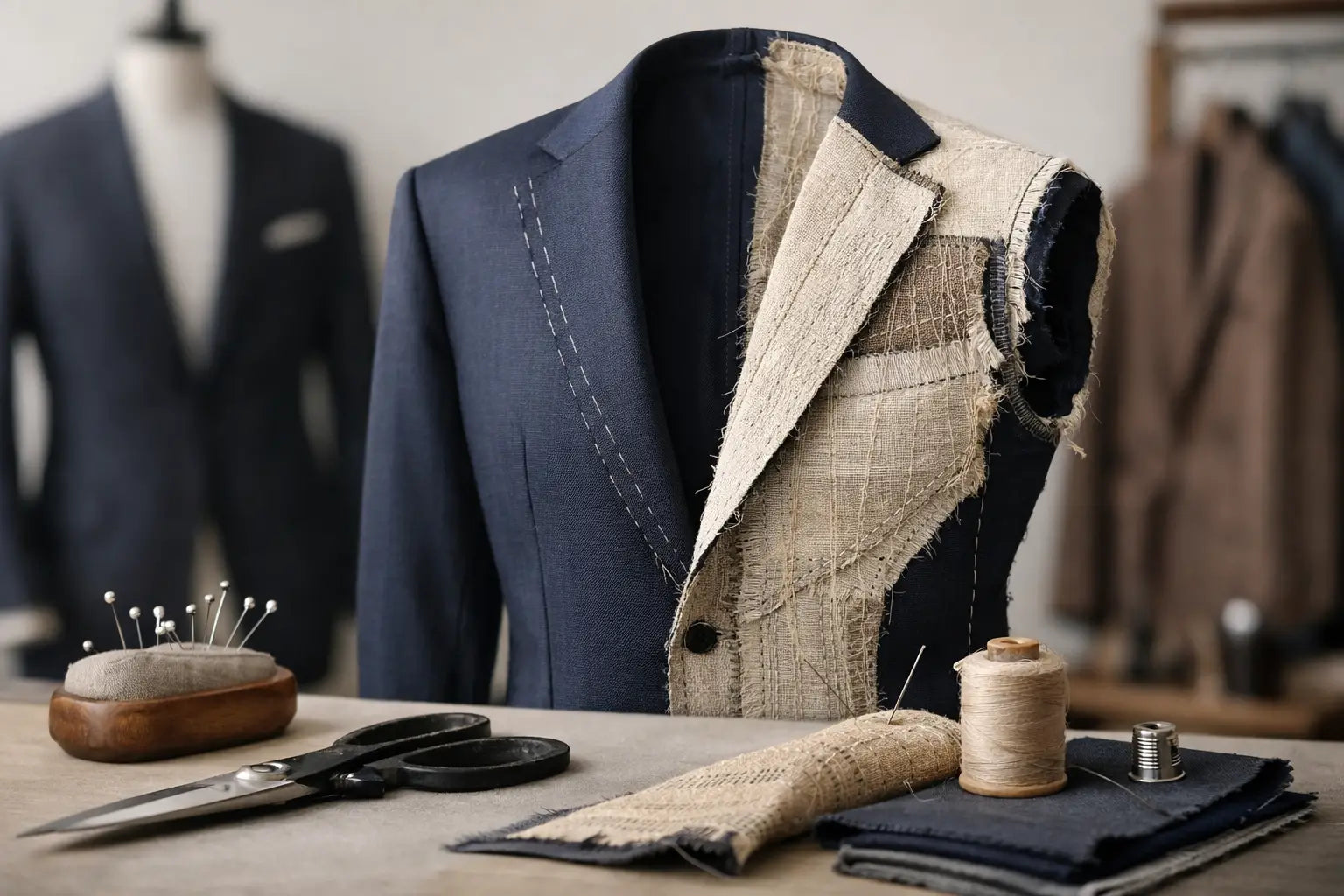
A Guide to Suit Canvas Construction
If a jacket looks impressive on the hanger but falls flat on the body, the problem is rarely the cloth alone. In most cases, the difference lies beneath the surface. Any serious guide to suit canvas construction begins there - with the hidden architecture that gives a jacket its shape, movement and authority.
Canvas construction is one of those details a gentleman may never see, yet he will feel it every time he fastens the front of his coat. It influences how the chest forms, how the lapel rolls, how the jacket settles through the day and how convincingly it holds its line over time. For a man who relies on his wardrobe to communicate judgement, discipline and presence, this is not a minor technicality. It is part of the garment’s character.
What suit canvas construction actually means
Inside a tailored jacket, between the outer cloth and the lining, sits an internal layer that gives the coat structure. Traditionally, this layer is made from canvas - usually a blend of natural fibres such as wool, horsehair or cotton. It is shaped, set and secured so the jacket develops form through the chest and lapel rather than merely hanging from the shoulders.
That internal framework is what distinguishes a tailored garment from one that is simply assembled. A well-constructed canvas allows the jacket to mould to the wearer over time. Instead of feeling rigid or flat, it becomes more personal with use.
In practical terms, suit canvas construction affects four things immediately. It changes the drape of the front, the elegance of the lapel roll, the comfort of the jacket in motion and the way the coat ages. These are not abstract concerns. They are visible in a boardroom, at a formal dinner and in every setting where your appearance speaks before you do.
A guide to suit canvas construction types
Not every jacket is built in the same way. Broadly, there are three construction methods: fused, half canvas and full canvas. Each has a place, but they do not offer the same result.
Fused construction
A fused jacket uses a synthetic interlining that is bonded to the outer cloth with adhesive. This makes production faster and more economical, which is why it is common in mass-market tailoring.
At first glance, a fused jacket can appear clean enough. The issue usually emerges with wear. Because the structure depends on glue rather than a floating canvas, the chest can feel flatter, the lapel can lack a natural roll and the coat often responds less gracefully to movement. Over time, heat, humidity and repeated pressing may also affect the bond.
That matters in climates such as Dubai, where temperature and humidity are not theoretical concerns. A garment built with adhesive can behave differently under stress than one built with a properly shaped canvas.
Half canvas construction
A half canvas jacket includes canvas through the chest and lapel area, while the lower portion of the front is typically fused. This gives more shape and refinement where it matters most, while keeping cost and weight more moderate than a full canvas garment.
For many men, half canvas offers a sensible middle ground. The lapels tend to sit better, the upper chest carries more life and the jacket usually feels more sophisticated than a fully fused alternative. That said, it does not deliver the same continuity of structure through the entire front of the coat.
Half canvas can be a respectable option when priorities are balanced between performance and price. It is not inferior in every context, but it is a compromise.
Full canvas construction
A full canvas jacket carries canvas through the full length of the front. This is the traditional standard associated with serious tailoring and, when executed well, it offers the most refined result.
The advantage is not simply prestige. A full canvas coat has a more organic drape, greater resilience and a more coherent silhouette from chest to skirt. It moves with greater ease because the internal structure is sewn and shaped rather than bonded into place. As the garment is worn, it begins to settle to the individual body it belongs to.
For clients who value depth of fit rather than superficial neatness, full canvas is often the more compelling choice. It asks more of the maker, but it gives more back to the wearer.
Why canvas matters more than many men realise
Most men assess a suit by cloth, brand label or immediate visual sharpness. Those things have their place, but they can distract from the more meaningful question: how is the jacket built?
A coat with fine fabric and weak internal construction may look polished for a short while, yet never develop true elegance in wear. By contrast, a well-canvassed jacket often becomes more convincing the longer it is owned. The front gains softness without collapse. The lapels gain expression. The whole silhouette feels less imposed and more natural.
This is where craftsmanship reveals itself. Good tailoring does not force shape onto the body. It creates a structure that supports the body and flatters it quietly.
The lapel roll, the chest and the line of the coat
When gentlemen speak of a suit feeling expensive, they are often responding to details they cannot immediately name. Three of the most important are the chest, the lapel and the balance of the front quarters.
The chest should have presence, not padding for its own sake. Proper canvas construction allows the chest to appear clean and composed, giving the torso strength without stiffness. This is especially important for men who spend long days between meetings, travel and evening engagements. A jacket should maintain dignity across hours of wear, not only in the first fifteen minutes.
The lapel roll is another signal. In a well-made canvassed jacket, the lapel curves with ease from the chest to the fastening point. It does not look pressed into submission. It has life. That subtle curve contributes enormously to the impression of quality.
Then there is the line of the coat. Canvas helps the front hang properly, reducing the lifeless, cardboard effect seen in lower-grade construction. The result is poise rather than stiffness.
Which construction is right for you?
This is where any honest guide to suit canvas construction should avoid absolutes. The right choice depends on how you wear tailoring, how often you wear it and what you expect from the garment.
If you need a suit occasionally and place budget above all else, a fused jacket may satisfy the brief, though it is unlikely to offer the depth of comfort or longevity expected in a luxury wardrobe. If you wear tailoring regularly and want a meaningful improvement in shape and performance, half canvas can be worthwhile.
If, however, you view a suit as part of your professional identity - something that must hold its authority across years, not seasons - full canvas is usually the more intelligent investment. It gives the jacket the best chance to become truly yours in wear, rather than simply acceptable at the point of purchase.
That does not mean every full canvas suit is automatically superior. The quality of pattern cutting, fitting and finishing still matters enormously. Canvas construction is powerful, but it cannot rescue poor proportions or careless craftsmanship.
Canvas construction and bespoke tailoring
The value of canvas becomes most apparent in bespoke work because the internal structure can be developed in harmony with the individual pattern. This is a different proposition from choosing a construction method off a rail.
In bespoke tailoring, the canvas is not just inserted. It is considered in relation to posture, shoulder line, chest shape and the way a client carries himself. A man with a more athletic build will require a different internal expression than a man with sloping shoulders or a prominent seat. The goal is not to create a generic ideal. It is to build a coat that presents the wearer at his most assured.
That is where a luxury tailoring house earns its reputation. Precision is not visible only in the seams. It is visible in restraint, in line and in how naturally the jacket inhabits the body.
How to recognise quality without seeing inside the jacket
Since the canvas is hidden, many clients wonder how they are meant to judge it. The answer lies in feel and behaviour.
Handle the lapel. A good canvassed lapel feels supple and dimensional rather than flat and papery. Observe the chest. It should have quiet shape, not a hollow or overly engineered look. Wear the jacket and move in it. The front should follow the body with composure.
You can also ask a direct question. Is the jacket fused, half canvassed or full canvassed? A serious tailor should answer plainly. If the explanation becomes vague, that tells you something as well.
The finest garments are built with conviction beneath the surface. The gentleman who understands that buys differently. He stops shopping for appearances and starts commissioning structure, comfort and presence. That is usually the moment tailoring becomes far more rewarding.