How Many Suit Fittings Do You Need?
A gentleman usually asks how many suit fittings he needs at the precise moment he decides he no longer wants compromise. He has worn jackets that pull at the waist, trousers that break awkwardly, and sleeves that never seem to finish at the right point. At that stage, asking how many suit fittings are required is not really about time alone. It is about understanding how a suit becomes truly his.
The short answer is this: for a genuine bespoke suit, most clients should expect at least two to three fittings, and sometimes more. That number is not excess. It is the process by which a garment is refined from an idea into a silhouette built entirely around the body it belongs to.
How many suit fittings are normal for bespoke?
If a tailor promises a perfect result with one brief measurement session and no meaningful fitting process, that is usually made-to-measure rather than true bespoke. There is nothing inherently wrong with made-to-measure when expectations are clear, but it is a different discipline.
A bespoke suit begins with a unique pattern drafted for the individual client. From there, fittings allow the tailor to test balance, proportion, drape, comfort and movement in real life rather than in theory. For most men, two or three fittings are standard. For a first commission, three is often the wiser expectation.
That said, the number can shift. A client with a very symmetrical frame and straightforward preferences may need fewer adjustments. A client with one shoulder lower than the other, a prominent seat, a forward posture, or very exacting style requirements may need more attention. Bespoke is not measured by speed. It is measured by accuracy.
What happens during each suit fitting?
Each fitting serves a distinct purpose. This is why asking how many suit fittings are needed only makes sense when you also understand what each stage is correcting.
The initial consultation and measurements
Strictly speaking, this is not always counted as a fitting, but it is the foundation of everything that follows. The tailor studies your posture, shoulder line, chest, stance and natural balance. He also considers how you want to be seen. A boardroom suit for a senior executive should not carry the same attitude as an evening suit for private events.
Fabric, cut, lapel shape, pocket style, trouser rise and finishing details are chosen here. More importantly, the tailor begins to understand your body in motion, not merely your measurements on paper.
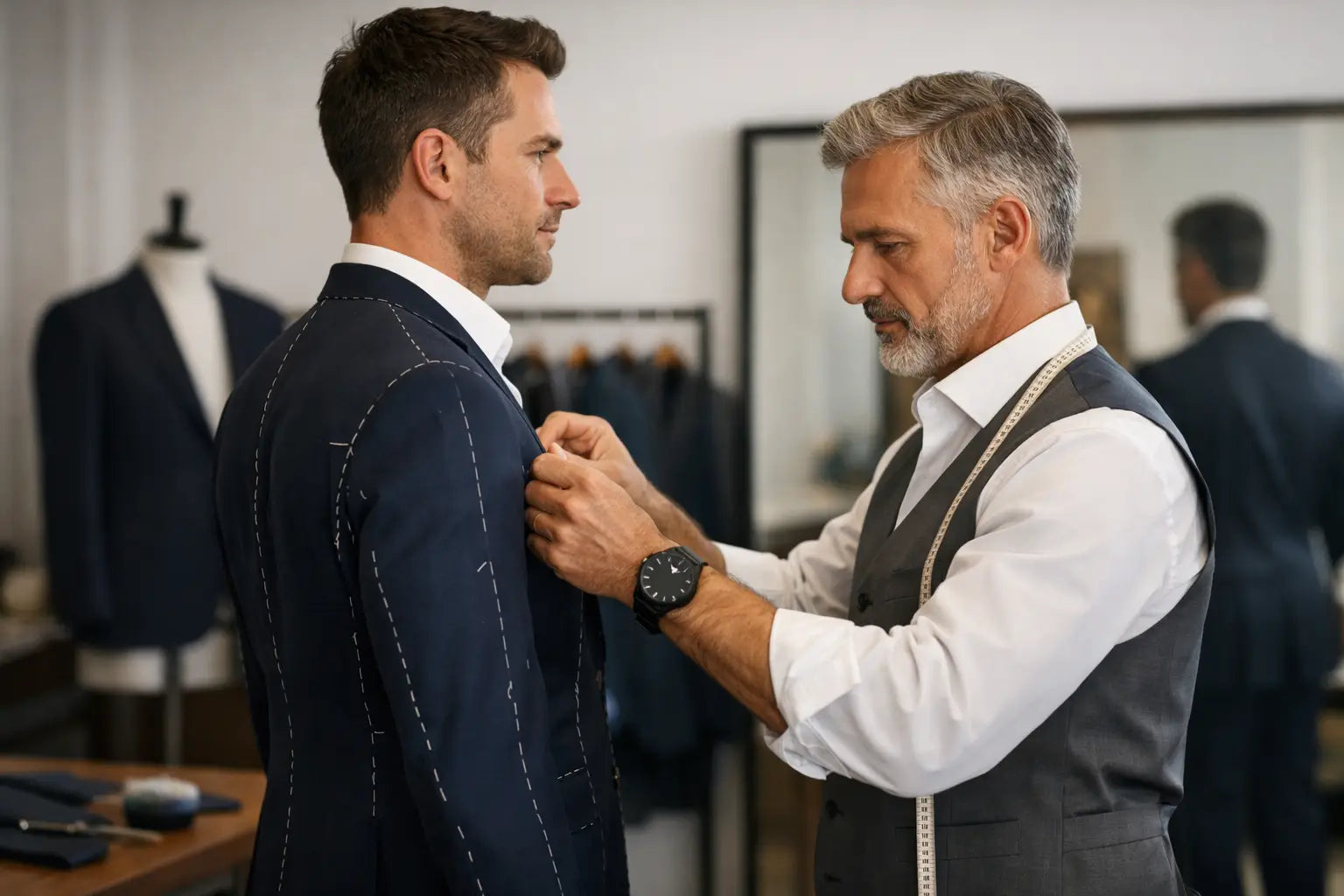
The first fitting
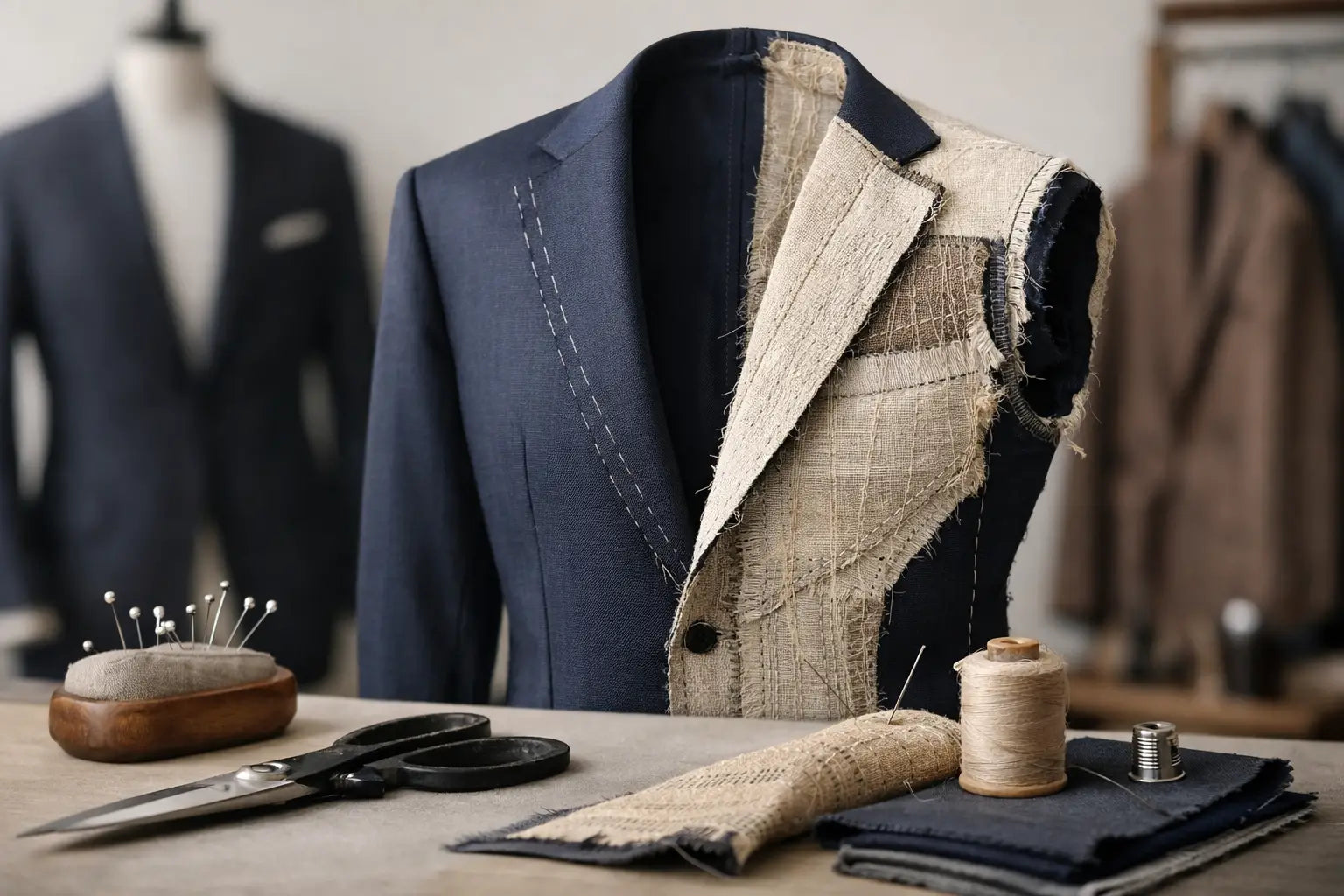
This is where bespoke starts to reveal itself. Depending on the house, the first fitting may be in a basted garment or a partially assembled suit. The purpose is not cosmetic polish. It is structural correction.
At this stage, the tailor examines jacket balance, collar position, sleeve pitch, chest shape, waist suppression, skirt line and trouser hang. He is looking for tension where cloth is fighting the body and fullness where the garment has not yet been disciplined into shape.
This fitting often brings the most significant changes. A sleeve may need to rotate because your arms rest slightly forward. The jacket front may need opening because your chest carries more depth than the draft first suggested. The trousers may require adjustment through the fork or seat so they sit cleanly without strain.
For many clients, this is the moment they realise why bespoke cannot be rushed. The suit is not simply being altered. It is being engineered around them.
The second fitting
By the second fitting, the large structural decisions have usually been made. Now the suit is becoming more precise. The tailor refines length, line and comfort. The jacket should sit with greater authority. The trousers should fall with more composure. The silhouette begins to look intentional rather than provisional.
This stage often addresses subtler points that matter enormously in wear. How much shirt cuff should show. Whether the trouser taper is clean without feeling narrow. Whether the jacket waist is shaped enough to flatter, but not so much that it feels theatrical. These decisions are small only on paper. On the body, they define presence.
The final fitting
The final fitting is about confirmation rather than discovery. By this point, the suit should feel settled and coherent. The tailor checks that movement is unrestricted, the cloth behaves properly when you stand and sit, and the finishing details remain balanced on the body.
Sometimes only the lightest refinements are needed. Occasionally, especially for first-time clients, one additional fitting is sensible. This is not a sign that anything has gone wrong. It is often the mark of a house that prefers exactitude over approximation.
Why some men need more fittings than others
No two bodies carry cloth in quite the same way. This is where luxury tailoring separates itself from transactional tailoring.
A man who trains regularly may have a developed chest and back paired with a comparatively narrow waist. Another may have a straight figure but a pronounced forward head posture from years at a desk. Someone else may stand with one hip slightly higher, affecting the entire line of the trousers. None of these characteristics are faults. They are simply realities the pattern must respect.
Lifestyle matters as well. If you spend much of the day in meetings, travelling between appointments, and stepping in and out of cars, your suit must perform elegantly under movement and long wear. If you prefer a sharper, more sculpted silhouette, that ambition may demand more refinement than a softer, more relaxed cut.
Weight fluctuation can also affect the number of fittings. If your body changes materially during the making process, additional correction may be needed to preserve the intended line. This is one reason experienced clients avoid commissioning important garments immediately before a major fitness phase or close to extensive travel.
Bespoke versus made-to-measure
The question of how many suit fittings are needed often becomes confused because many clients have only experienced made-to-measure. In that model, a pre-existing pattern is adjusted according to measurements and style options. You may have one fitting, or sometimes none at all beyond the measuring appointment.
Bespoke is a different proposition. The pattern is created for you from the beginning, then refined through fittings that respond to your actual figure and posture. That process demands more time, but it also gives the tailor more control over the final result.
This is why a discerning client should be cautious of simple promises. Fewer fittings may sound convenient, but convenience is not the highest standard in tailoring. Precision is.
How to make each fitting count
A fitting is only valuable if the client approaches it properly. Arrive in the shoes you expect to wear with the suit, or at least in a pair with similar height and character. Bring the type of shirt you favour. Small differences in collar height, cuff length and shoe shape can affect final balance more than most men expect.
It also helps to be honest about comfort. Some clients believe they should tolerate tightness because a tailored suit is meant to feel close. A good bespoke suit should feel clean and composed, not restrictive. Equally, asking for excessive ease out of habit can dull the silhouette. The tailor’s role is to guide that line between elegance and comfort, but the client must speak candidly.
The best fittings are collaborative. You are not there to perform expertise. You are there to communicate how the garment feels, how you live in it, and what impression you want it to create.
In Dubai, timing matters more than clients think
In a city such as Dubai, where business calendars move quickly and social commitments often arrive with little notice, clients sometimes hope a bespoke process can be compressed into impossibly narrow timelines. It can be expedited to a point, but acceleration always has limits if the standard is genuinely high.
Humidity, travel schedules and packed diaries all place pressure on appointments. That is precisely why the fitting schedule should be treated as part of the commission, not an inconvenience surrounding it. A suit of real distinction is not finished when the cloth is sewn. It is finished when the wearer stands in it and nothing seems accidental.
For that reason, the right number of fittings is not the minimum possible. It is the number required to achieve calm, exact fit without forcing the process. In a proper bespoke house, that judgment is made with discipline, not guesswork.
If you are investing in a suit to represent your name, your position and your standards, allow the garment the time to become unmistakably yours. That is where confidence begins.