How to Fix Common Suit Fit Problems
A suit can be made from excellent cloth, finished with restraint, and cut in all the right proportions on paper - yet still fail the moment it is worn. The reason is simple: to fix common suit fit issues, you have to look beyond size and focus on balance, posture, and how the garment moves with the man inside it. That is where the difference between merely expensive tailoring and true refinement becomes obvious.
For men who rely on presentation as part of their professional presence, fit is not a minor detail. It shapes authority, composure, and ease. A jacket that pulls at the button stance or trousers that collapse around the ankle do more than look untidy. They alter the silhouette, distract the eye, and diminish the impression the suit should create.
Why common suit fit problems keep happening
Most suit fit problems begin with a compromise made too early. Off-the-peg garments are cut for standardised proportions, but very few men are standard. One shoulder may sit lower than the other. The chest may be broader than the waist. A man who trains regularly, travels often, or spends long hours at a desk will carry himself differently from the generic block used to produce ready-made tailoring.
Then there is the issue of priorities. Many men judge a suit by immediate comfort in the changing room, often choosing extra room where precision is needed. Others buy for one part of the body and accept poor fit elsewhere, believing alterations can solve everything afterwards. Some adjustments are straightforward. Others are costly, awkward, or simply not worth attempting.
The better approach is to understand which faults are visual, which are structural, and which point to a garment that was never right to begin with.
Fix common suit fit faults at the shoulder first
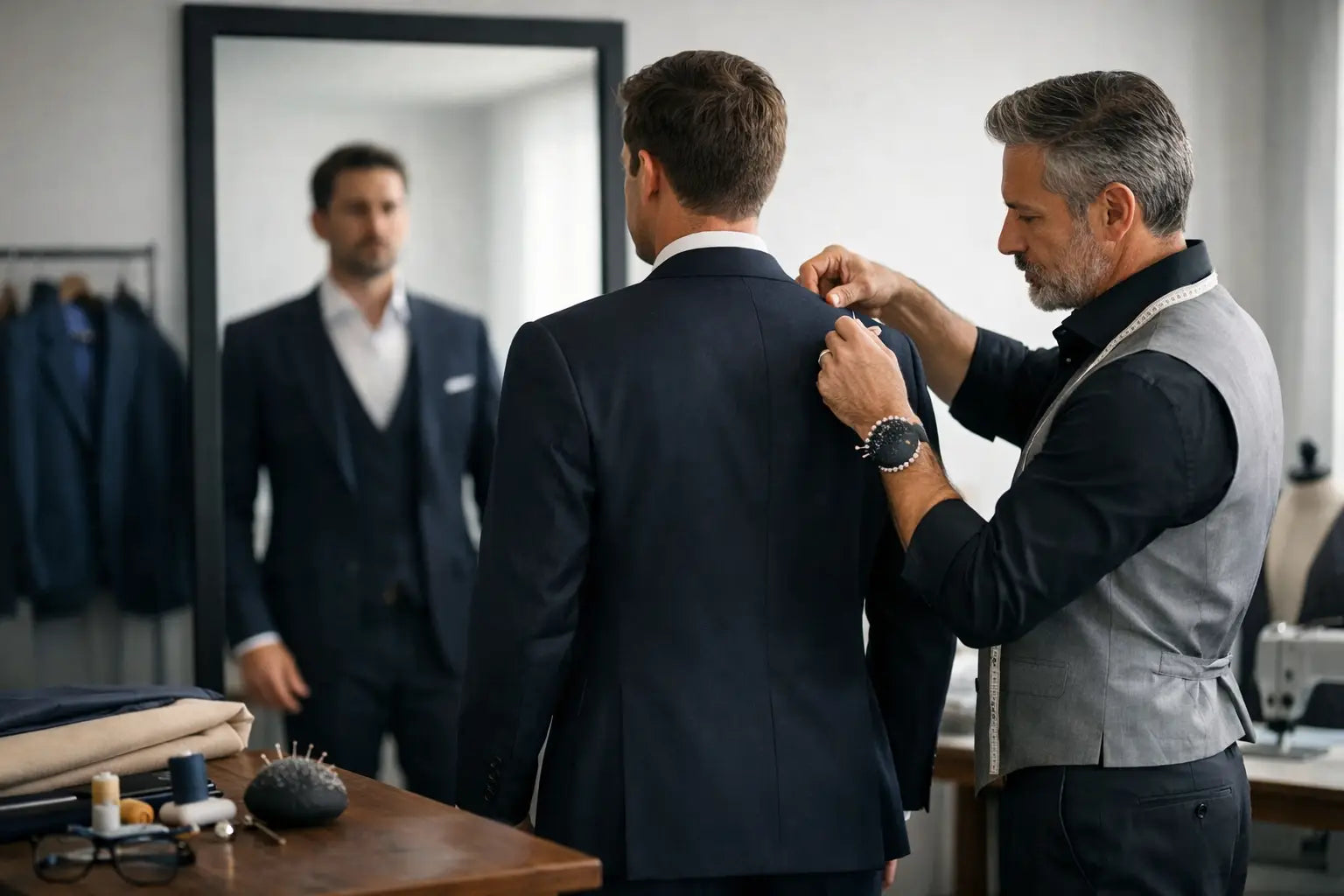
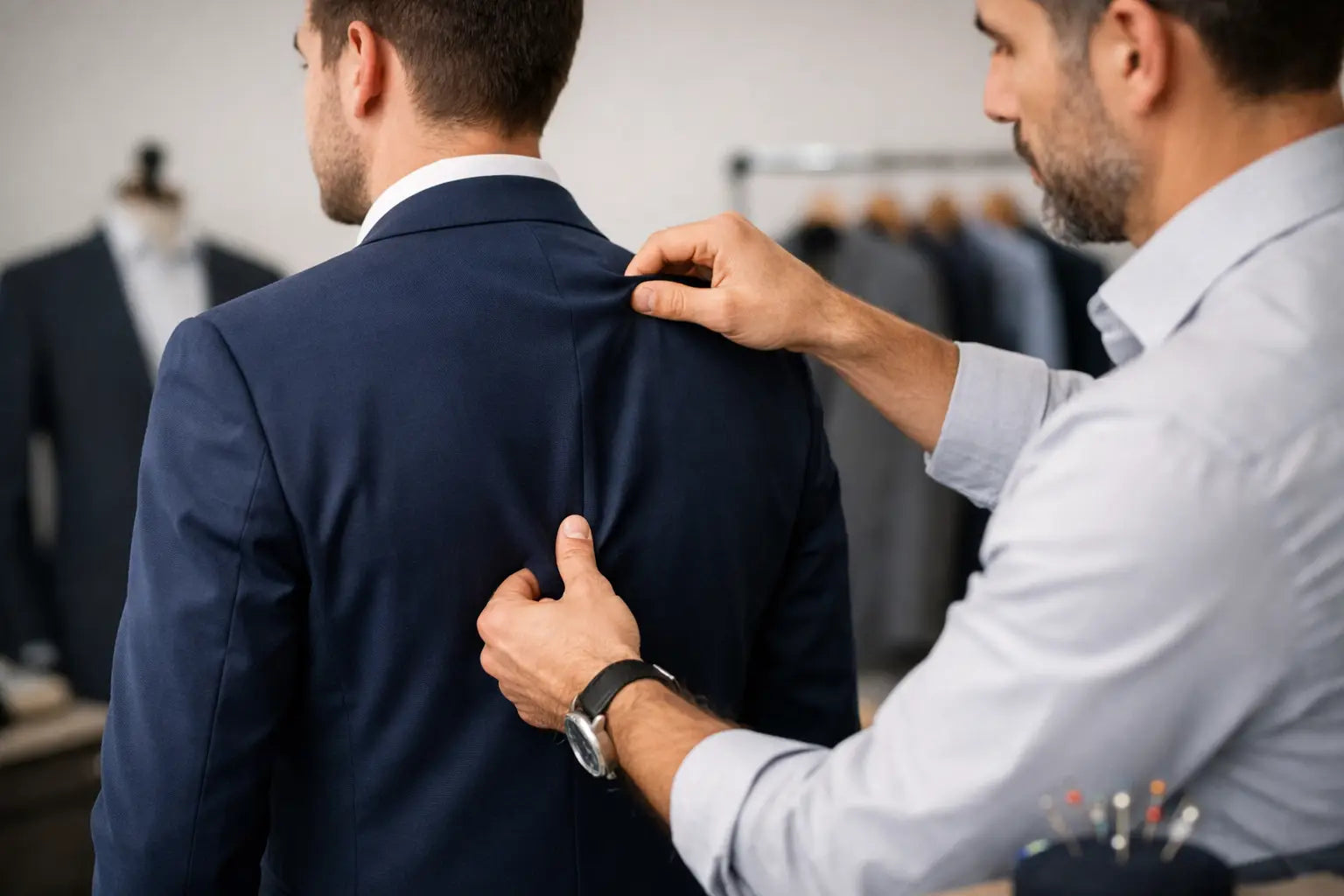
If the shoulders are wrong, the rest of the jacket rarely recovers. This is the first area an experienced tailor studies because it governs the line of the sleeve, the drape of the chest, and the overall posture of the coat.
A shoulder that is too wide creates an empty shelf beyond the natural shoulder point. The sleeve head may dip, and the whole jacket begins to look borrowed. Too narrow, and the fabric catches at the upper arm and distorts the chest. In both cases, the wearer appears constrained rather than composed.
Minor imbalance can sometimes be refined through careful adjustment, particularly if one shoulder sits lower and the coat needs subtle correction. But significant shoulder alteration is complex. It affects the collar, sleeve pitch, and upper-body balance. This is one of those areas where the honest answer is often that the jacket should not have been chosen in the first place.
The ideal shoulder does not announce itself. It follows the body cleanly, with enough structure to create elegance and enough sensitivity to avoid stiffness.
The collar tells the truth
A well-cut collar should sit close to the neck without gaping or collapsing. If there is a roll of excess cloth beneath the collar, or the back neck stands away from the shirt, the jacket is not balanced correctly for the wearer’s posture.
This matters more than many realise. A poor collar fit immediately signals that the coat is not built around the body it belongs to. Sometimes the cause is a rounded back, erect posture, or sloping shoulders. Sometimes it is simply a generic pattern forced onto an individual frame.
A skilled tailor can improve certain collar issues, but only within limits. When the balance of the entire jacket is wrong, surface corrections tend to create new problems elsewhere.
Chest and waist suppression should create shape, not strain
A good suit should define the torso without looking tight. This is where many men misjudge fit. They ask for a slimmer jacket when what they actually need is a cleaner line through the waist and a neater chest balance.
If the front button pulls into an X-shape when fastened, the coat is too tight through the waist or chest. If the quarters flare open dramatically below the button, the balance may be off or the seat may be too snug against the hips. On the other hand, too much fullness through the body makes even fine tailoring look soft and imprecise.
The answer is not always to take the jacket in as much as possible. It depends on body shape, cloth weight, and intended use. A business suit worn through long days should retain elegance when seated, standing, and moving. A dinner jacket can tolerate a slightly cleaner, closer silhouette because the demands on it are different.
True refinement lies in controlled suppression - enough to create presence, never so much that the cloth looks under tension.
Sleeves and jacket length change the entire impression
Sleeve length is one of the easiest corrections, yet one of the most frequently overlooked. Too long, and the hands disappear, making the jacket look heavy. Too short, and the proportion turns abrupt. In most cases, a modest amount of shirt cuff should remain visible, giving definition to the forearm and polish to the overall line.
But length alone is not the whole story. Sleeve pitch - the angle at which the sleeve is set according to how the arms naturally rest - affects comfort and appearance. If horizontal creases form across the front or back of the sleeve, the jacket may be fighting the wearer’s natural stance.
Jacket length is more divisive because taste plays a role. Some men prefer a shorter, sharper coat. Others favour a more classical line. Still, proportion should lead the decision. A jacket that is too short can make the wearer look broader and less balanced, especially across the seat and thigh. Too long, and it loses energy.
A well-judged jacket length frames the body rather than dominating it. It should feel intentional, not trend-driven.
Fix common suit fit issues in trousers with restraint
Trousers are often treated as secondary, which is a mistake. A beautifully fitted jacket loses its authority if the trousers twist, pinch, sag, or break awkwardly over the shoe.
The rise is the first point to examine. If it is too low, the trousers tend to pull at the front and slide out of position during the day. Too high without proper balance, and they can feel severe. The correct rise allows the waistband to sit where the trousers can hang cleanly from the body.
Seat fit comes next. Excess cloth beneath the seat creates a loose, untidy drape. Too tight, and the back seam strains while the pockets pull open. Neither looks distinguished. The line should be clean, with enough ease for movement and no unnecessary fullness.
Break is another area where preference matters. A full break may suit a more traditional wardrobe, while a slight break or clean no-break finish can look more contemporary. The right choice depends on trouser width, cloth, shoe shape, and the wearer’s style. What matters is consistency. The hem should meet the shoe with purpose, not hesitation.
The taper must respect the wearer
A heavily tapered trouser can look sharp in still photographs and disappointing in real life. It may shorten the leg visually, disrupt the drape, and cling in motion. A cleaner silhouette usually comes from proportion rather than aggression.
The leg should narrow with control, enough to refine the line without making the lower half feel restricted or overly styled. For many professional men, discretion is the stronger choice.
What alterations can fix - and what they cannot
There is a persistent belief that any suit can be corrected by a competent alterations tailor. This is optimistic. Sleeve length, trouser length, waist suppression, and modest seat or side adjustments are usually manageable. Shoulder width, armhole shape, collar balance, and major chest reconstruction are different matters.
This is where cost and judgement come in. A suit that requires extensive surgery is rarely a wise investment, no matter how attractive the cloth or label may be. The smartest clients understand that tailoring should refine a sound foundation, not rescue a flawed one.
In bespoke work, these issues are addressed at the pattern stage and then tested through fittings. That is precisely why the process exists. The garment is shaped around the individual, not forced into compliance afterwards.
The real standard of fit
The finest suit does not merely fit when you stand still in front of a mirror. It holds its line when you walk into a meeting, sit through dinner, reach for a handshake, or spend twelve hours moving through a demanding day. It should sharpen your outline while allowing complete ease.
That standard is especially relevant in a city such as Dubai, where presentation carries unusual weight and clothing is often expected to perform in both formal and highly social settings. Precision matters, but so does comfort, climate, and the way a man wishes to be perceived.
A suit should never ask for tolerance. It should offer quiet certainty. When the shoulder sits correctly, the collar rests cleanly, the waist is shaped with discipline, and the trousers fall with intention, the result is not simply a better garment. It is a more convincing presence.
If a suit feels almost right, it usually is not right at all. The details that seem small in isolation are the very ones that define the whole impression. The wise choice is to correct what can be corrected, reject what cannot, and expect your tailoring to do more than cover the body - it should honour it.