Italian Suit Construction Review
A suit can look impressive on a hanger and still fail the moment it is worn. The shoulder may sit too hard, the chest may feel lifeless, the lapel may refuse to roll properly, and the coat may collapse after a season of regular use. That is why an Italian suit construction review matters. For a man who understands that presentation is part of influence, construction is not a technical footnote. It is the difference between a suit that merely fits and one that carries authority.
Italian tailoring holds a particular fascination because it combines elegance with ease. At its best, it creates a silhouette that feels refined rather than rigid, shaped rather than forced. Yet not every Italian suit is made to the same standard, and not every hallmark of Italian style suits every man, every climate, or every professional setting. A proper review of construction has to go beyond labels and look at what is actually inside the garment.
What an Italian suit construction review should examine
The first point is simple: construction determines behaviour. It affects how the jacket moves, how it drapes across the chest, how it settles at the waist, and how long it retains its shape. Many men focus first on cloth, and understandably so. Fabric is visible, immediate, and easy to appreciate. Construction is quieter. You feel it more than you see it.
In an Italian suit construction review, the key areas are the canvas, the shoulder, the chest, the armhole, the balance of the coat, and the finishing. These are not isolated details. They work together. A fine cloth cut on a poor pattern and fused carelessly will never produce the same result as a balanced jacket built with conviction and restraint.
Italian construction is often associated with softness. That softness can be exceptional when done well. It can also be misunderstood. Soft does not mean shapeless. A superior Italian jacket still has structure, but it is placed with intelligence. The goal is fluidity, not weakness.
Canvas, fusion and the truth behind drape
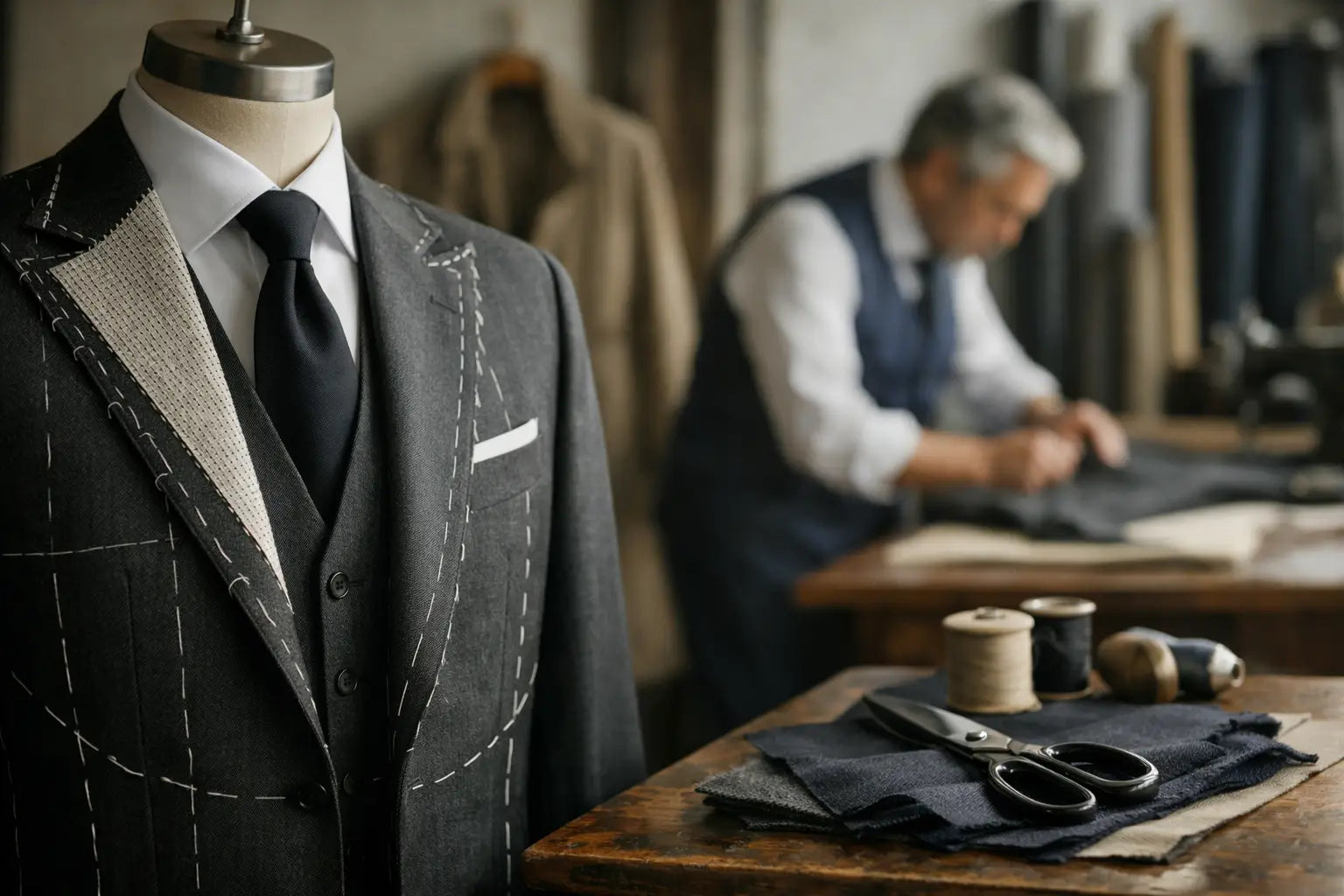
If there is one area that deserves close attention, it is the inner construction of the jacket. A fully canvassed coat uses layers of canvas between the outer cloth and the lining, allowing the jacket to mould gradually to the wearer. This usually gives a richer drape through the chest and lapel, and over time the garment develops a more personal character.
Half canvas can also be respectable, particularly when well executed. For some clients it offers a practical balance between performance and cost. The issue is not that half canvas is automatically inferior. The issue is whether the maker has used it thoughtfully and whether the rest of the jacket justifies the compromise.
Fused construction, by contrast, relies on adhesive to bond the layers. In lower-grade garments this is where many problems begin. The chest can appear flat, the lapel can look dead, and heat or wear may eventually cause bubbling. For a man investing in tailoring for boardrooms, private meetings, formal events, or regular travel, fused jackets rarely deliver the depth or longevity expected of true luxury.
An Italian jacket built with proper canvas tends to move with greater grace. It responds to the body rather than resisting it. That is one reason why superior tailoring feels calm when worn. It is not fighting the wearer.
The Italian shoulder - elegant, but not universal
The shoulder is one of the clearest signatures of Italian tailoring. Depending on the house or region, it may be lightly padded, entirely natural, or cut with a touch more expression. In some interpretations, there is a soft sleevehead with subtle fullness. In others, the line is clean and understated. The common thread is a rejection of unnecessary heaviness.
This can be immensely flattering, especially for men who want sophistication without bulk. A softer shoulder often gives the coat a more modern and effortless presence. It works particularly well in climates where comfort matters and where an overbuilt jacket feels out of place.
Still, there are trade-offs. A man with very sloping shoulders may benefit from more support. A client seeking a sharper, more formal silhouette for conservative business environments may prefer a little more structure. Italian construction excels when it is adapted to the wearer, not when it is copied as a style exercise.
That is where bespoke tailoring separates itself from ready-made interpretation. A true bespoke shoulder is not chosen because it is fashionable. It is chosen because it serves the man wearing it.
Chest and lapel - where authority quietly appears
A strong jacket rarely announces itself through loud design. More often, it reveals its quality through the chest and lapel. The chest should have life. It should feel shaped, not inflated, with enough substance to create presence without stiffness. This is one of the subtler achievements of excellent Italian construction.
The lapel is equally revealing. A well-made lapel rolls with ease and sits cleanly against the body. It should not look pressed into submission. In better jackets, the lapel has a natural curve that gives the front of the coat depth and elegance. This contributes more to the perception of luxury than most men realise.
When the chest is hollow or the lapel lies flat and lifeless, the suit loses conviction. Even expensive cloth cannot disguise that. For executives and entrepreneurs, these details matter because they affect the entire impression of composure.
Sleeve pitch, armholes and movement
The finest suit is not merely seen. It is lived in. A jacket may appear correct while standing still, then reveal its flaws the moment the wearer reaches for a document, enters a car, or sits through a long meeting. This is where construction and pattern become inseparable.
Italian tailoring often favours higher armholes, which can improve mobility while keeping the body of the coat stable. Done correctly, this allows a cleaner silhouette and more elegant movement. Done badly, it becomes restrictive and uncomfortable.
Sleeve pitch matters just as much. Arms do not hang the same way on every man. If the pitch is wrong, wrinkles appear immediately and the coat never feels natural. This is one of the reasons why standard sizing so often disappoints successful men who are accustomed to precision elsewhere in life. A suit should respect the posture, stance and habits of the individual, not ask the individual to adapt to the garment.
Cloth and construction must be in dialogue
An Italian suit construction review that ignores fabric is incomplete. Construction does not exist in isolation. The cloth must support the intended shape. A supple wool with an open handle will behave differently from a crisp high-twist fabric. A lightweight cloth can be marvellous in warm conditions, but if the construction is too soft, the coat may lose definition. Equally, a structured build in an already firm cloth can feel overly severe.
The best Italian tailoring understands this dialogue. It balances weight, body and softness according to the client’s needs. A man who travels frequently between warm climates and air-conditioned interiors may require something different from a man who wants a formal winter wardrobe. Neither approach is more correct. Precision lies in choosing well.
Finishing - the visible sign of invisible standards
Many finishing details are small, yet they reveal discipline. Buttonholes should be clean and confident. Lining should sit smoothly without pulling. Pattern matching, edge finishing, collar attachment and handwork around the lapel all speak quietly about the maker’s standards.
These details do not matter because they are decorative. They matter because they reflect control. A suit built entirely around the body it belongs to should show consistency at every level. Luxury is not noise. It is assurance.
For clients who commission bespoke garments, this is especially relevant. The fitting process should refine not only the measurements but also the way the jacket behaves in motion. That is where a house such as DONFIORITO distinguishes itself - not by repeating generic tailoring language, but by shaping a garment around how a man wishes to be perceived and how he needs to feel when wearing it.
Final thoughts in this Italian suit construction review
The finest Italian suit construction is persuasive because it never looks laboured. It creates line, ease and presence without visible strain. Yet the right choice always depends on the wearer. Some men need more formality, others more softness, others a balance between the two. The real measure of quality is not whether a suit follows an Italian ideal, but whether its construction serves the man with intelligence, comfort and authority. If a jacket can do that from the first fitting to years of wear, it has earned its place in a serious wardrobe.