Bespoke vs Ready-to-Wear: What Defines Presence
A suit can be technically expensive and still feel borrowed. The shoulder may sit too wide, the trouser may break untidily, or the jacket may pull when you take your seat at the boardroom table. This is where bespoke vs ready-to-wear becomes more than a question of shopping preference. It is a decision about whether your wardrobe adapts to your body and life, or whether you adapt to it.
For the man whose appearance forms part of his professional language, fit is not a decorative detail. It influences posture, ease and the quiet authority with which a garment is worn. Ready-to-wear has a place, particularly when speed and accessibility matter. Bespoke, however, is made for a different expectation: a suit built entirely around the body it belongs to.
Bespoke vs Ready-to-Wear: The Essential Difference
Ready-to-wear garments are produced to standardised size charts. A size 40 jacket, for example, is developed around an assumed set of proportions: chest, shoulder width, sleeve length, waist and posture. Even when the garment is beautifully made, it begins as a design for an average body rather than for yours.
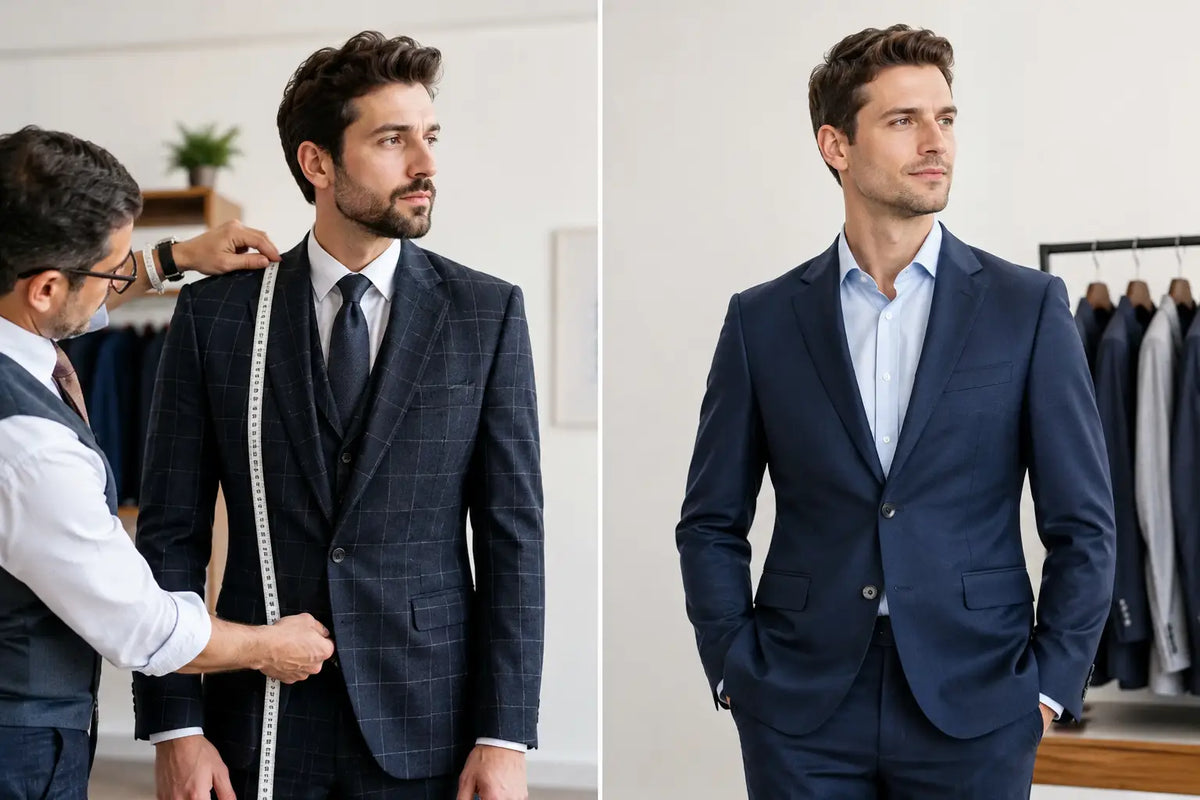
Bespoke tailoring begins with no such assumption. A private consultation establishes how you work, travel and prefer to be seen. Measurements are taken, but the process goes well beyond numbers. A skilled tailor observes the slope of the shoulders, the balance of the stance, the position of the head, the shape of the chest and the movement of the arms. These details inform a unique paper pattern, created for one client alone.
The distinction is especially meaningful for men who struggle with standard sizing. Athletic builds often find that a jacket fitting the shoulders overwhelms the waist. Taller men may encounter sleeves and trouser lengths that never quite settle correctly. Others have subtle asymmetries that are entirely natural but difficult for a standard garment to accommodate. Bespoke does not attempt to disguise these realities with a compromise. It accounts for them from the first cut.
What Ready-to-Wear Does Well
It would be simplistic to suggest that ready-to-wear has no merit. Well-chosen ready-to-wear can be an intelligent option for a last-minute occasion, a less formal garment or a man who falls close to the proportions used by a particular house. The selection is immediate, the price is usually lower, and the garment can often be adjusted to improve sleeve length, trouser hem and waist suppression.
The limitation lies in the starting point. Alterations refine an existing garment; they do not redesign its architecture. A tailor may shorten sleeves or take in the waist, but cannot fundamentally change a shoulder line without considerable difficulty and cost. Nor can alterations fully correct the balance of a jacket that was cut for a different posture.
There is also a question of expression. Ready-to-wear collections are designed around commercial appeal, seasonal direction and broad demand. They offer style choices, certainly, but those choices have already been made for a large audience. For some wardrobes, that is entirely sufficient. For others, especially those who value a recognisable and consistent personal image, it can feel limiting.
The Value Is in the Process
The Art of Bespoke is not simply the finished suit. It is the series of considered decisions that produce it.
At the consultation stage, cloth is selected according to use rather than appearance alone. A businessman who moves between Dubai meetings and frequent international travel may require a cloth with resilience, breathability and a refined crease recovery. A groom may prefer a more expressive texture or a formal sheen that would feel misplaced in an office. The right fabric must perform as well as it looks.
Then comes the question of silhouette. A sharper, more structured shoulder can create command and definition. A softer construction may suit a man who prefers ease, movement and an understated European line. Lapel width, jacket length, pocket style, trouser rise and the amount of waist shaping all contribute to the final impression. None should be selected in isolation.
Fittings are where intention becomes precision. The garment is assessed on the client rather than on a hanger, allowing the tailor to correct balance, refine drape and ensure comfort through movement. This stage is not an inconvenience between purchase and delivery. It is the point at which a suit begins to acquire its individual character.
Fit Changes More Than Appearance
A properly fitted suit should never announce its effort. The lapels should lie cleanly against the chest. The collar should meet the shirt collar without a visible gap. The sleeve should follow the arm naturally, and the trousers should fall with controlled ease rather than excess cloth around the seat and thigh.
These technical details have a practical effect. When a jacket does not pull across the back, you are less conscious of reaching for a document or greeting a client. When the trouser rise is correctly established, you can sit for a long lunch or a flight without constant adjustment. Comfort creates composure, and composure is visible.
This is why bespoke is often misunderstood when viewed only through the lens of luxury. The value is not confined to exclusivity or a label. It rests in the experience of wearing a garment that feels settled from morning to evening. For executives and entrepreneurs, that assurance can be a meaningful professional advantage.
Craftsmanship, Time and Cost
The greatest trade-off in bespoke is time. A ready-to-wear suit can leave with you that day. A bespoke commission requires consultation, pattern development, fittings and patient finishing. If you need formalwear for an event next week, ready-to-wear may be the realistic answer.
Bespoke also commands a higher investment. That investment reflects individual pattern cutting, skilled handwork, premium cloth and the time required to make repeated adjustments. It is not appropriate for every garment in a wardrobe. A man may sensibly own ready-to-wear pieces for casual rotation while choosing bespoke for the suits that carry the greatest professional and social importance.
The cost should also be considered over wear rather than at the point of purchase alone. A suit that fits beautifully is more likely to be worn often, maintained carefully and retained for years. Timeless cloth and disciplined styling matter here. A navy or charcoal suit with an exceptional cut will outlast many seasonal purchases, both physically and aesthetically.
When Bespoke Is the Right Choice
Bespoke is particularly compelling when standard garments consistently fail you, when your work places you in high-visibility settings, or when you want your wardrobe to communicate something precise. It is also valuable at moments when photographs, introductions and first impressions endure: a wedding, a keynote address, a major negotiation or a significant personal celebration.
It is not necessary to commission an entire wardrobe at once. One impeccably made business suit can establish the foundation. From there, a second cloth can be chosen for travel, a lighter jacket for warmer months, or a formal evening garment for occasions that demand greater ceremony. Each commission becomes easier because the pattern evolves with your preferences.
At DONFIORITO, this is treated as a personal relationship rather than a transaction. The objective is not to place a man in a fashionable suit. It is to understand the presence he wishes to project, then create a garment capable of carrying it with ease.
A More Considered Standard
The question is not whether ready-to-wear is good or bad. It is whether it can answer the requirements you place on your clothing. For convenience, occasional use or a straightforward need, it may be exactly right. For a suit expected to perform at the highest level, bespoke offers a degree of control that standard sizing cannot replicate.
The best next step is simple: consider the suit you reach for when the room matters. Notice where it restricts you, where it loses shape, and whether it reflects the man you intend others to meet. Those observations are the beginning of a wardrobe built with purpose.