

المقال: A Modern Guide to Business Casual Tailoring
A Modern Guide to Business Casual Tailoring
Business casual is often treated as a relaxed version of office dress. For a man whose appearance carries professional weight, it requires more thought than that. A guide to business casual tailoring begins with a simple principle: the absence of a tie should never mean the absence of intention. The right garments feel at ease, yet retain the proportion, precision and quiet authority associated with fine tailoring.
The challenge lies in balance. Dress too formally and you appear disconnected from the setting. Dress too casually and the impression loses definition. Tailoring provides the middle ground, shaping a wardrobe that moves naturally from private meetings to client lunches, evening engagements and travel without diluting personal presence.
What Business Casual Tailoring Really Means
Business casual is not one uniform. Its standard changes with the industry, venue and city. A creative founder may wear a soft jacket with a fine-knit polo, while a finance executive may be better served by a crisp shirt, tailored trousers and an unstructured blazer. In Dubai, where polished presentation is often expected even in less formal environments, the quality of fit is particularly visible.
The common thread is considered ease. A tailored business casual wardrobe is built around garments with clean lines, controlled proportions and fabrics that perform comfortably. It is less ceremonial than a formal suit, but it should still look built around the body it belongs to.
This distinction matters because off-the-rack casualwear is designed around averages. A jacket may be broadly acceptable across the shoulders but too loose through the waist. Trousers may sit correctly at the hip but collapse around the seat or break excessively at the shoe. Each small compromise weakens the whole impression. Bespoke tailoring corrects these details before they become visible distractions.
Start With the Jacket, Not the Suit
For most men, the tailored jacket is the foundation of business casual dressing. It introduces structure without asking for the formality of a matching suit. A well-cut jacket sharpens the shoulder line, defines the torso and gives even simple separates a sense of command.
The ideal business casual jacket is usually softer in construction than a boardroom suit. A lighter canvas, natural shoulder and reduced lining allow the garment to follow the body rather than sit rigidly upon it. This is especially valuable in warm climates, where comfort influences how confidently a man carries himself.
Navy remains the most versatile first choice. It works with grey, stone, tobacco, olive and cream trousers, and it is equally credible with a shirt, knit polo or fine merino crew neck. Mid-grey is another dependable option, although it is slightly more formal in character. For a man with an established wardrobe, muted brown, olive or textured blue can bring depth without appearing decorative.
The jacket must fit with precision. The shoulder should end where your own shoulder ends. The collar should rest cleanly against the shirt collar. The waist should shape the silhouette without pulling at the button, and the sleeves should reveal a measured amount of shirt cuff. These are restrained details, but they are the details people read first.
Texture creates distinction
Business casual benefits from fabric texture because texture makes a garment feel less corporate while preserving refinement. Hopsack wool, high-twist wool, wool-silk-linen blends and restrained checks offer visual interest without demanding attention.
The choice depends on how the garment will be worn. An open-weave wool jacket is elegant and breathable but may not suit a man who travels frequently and needs maximum crease resistance. A wool blend with a modest amount of resilience can be a better practical choice. The most luxurious cloth is not always the right cloth if it does not suit the life in which it will be worn.
Trousers Should Carry the Same Discipline
Business casual trousers are not simply formal trousers worn without a jacket. Their cut and cloth should support a more relaxed composition while maintaining a clear silhouette. Flat-front trousers in wool, cotton, cotton-linen or a refined stretch cloth are usually the strongest starting point.
Fit begins at the waist. Trousers should sit securely without relying on a belt to hold them in place. Through the seat and thigh, there should be sufficient room to sit, travel and move with ease, but not so much that the fabric gathers or sags. From the knee down, the line should taper gently according to the wearer’s build and preferred shoe.
A clean, slight break at the shoe often gives business casual trousers the best finish. Too much break looks untidy; no break can look overly fashion-led unless the entire outfit has been designed with that intention. The objective is proportion, not a trend.
Chinos can have a place in a tailored wardrobe, particularly in stone, navy or olive, but they should not resemble weekend trousers. A refined cotton twill, a clean waistband and a carefully balanced leg make all the difference. For more senior or client-facing situations, wool trousers typically offer greater authority with very little additional formality.
Shirts and Knits Set the Formality Level
The shirt is where a business casual look becomes either precise or forgettable. A bespoke shirt with an open collar can look effortless, but only when the collar has enough structure to frame the face. A collar that collapses beneath a jacket immediately reduces the effect of otherwise excellent tailoring.
White and pale blue remain essential, particularly for meetings where clarity and confidence matter. Beyond these, consider soft blue stripes, light grey, ecru or discreet micro-patterns. They introduce personality while staying appropriate for professional settings.
For less formal appointments, a fine-gauge polo or merino knit can replace the shirt. This works best when the jacket has a softer construction and the knit fits close enough to maintain a clean chest and waistline. Thick casual polos and loose knitwear tend to fight against tailored proportions. The result is neither relaxed nor refined.
If you wear a T-shirt beneath a jacket, choose carefully. It should be substantial, well-fitted and impeccably finished at the neck. This combination is suitable for certain modern business settings, but it is not a universal substitute for a collar. Where the room includes conservative clients, formal hosts or senior decision-makers, a shirt or fine polo remains the more assured choice.
Shoes, Belts and the Details That Decide the Look
Business casual footwear should be elegant enough to support tailoring. Penny loafers, tassel loafers, suede derbies and clean leather loafers are natural choices. Suede offers a softer texture that works particularly well with unstructured jackets and separates, while polished calf leather lends more formality.
Trainers require greater judgement. Minimal leather trainers can work with tailored trousers in a contemporary, informal environment, but their condition must be immaculate and their shape restrained. Thick soles, conspicuous branding and athletic styling undermine the line of the trousers. When uncertain, choose loafers.
A belt should match the overall level of dress, rather than merely the shoe colour. Fine leather in dark brown, black or deep burgundy is dependable. In some tailored trouser designs, side adjusters create a cleaner waistline and remove the need for a belt entirely. This is a small refinement, but it allows the trousers to sit as they were intended.
Avoid treating accessories as an afterthought. A discreet watch, a well-made leather portfolio and considered eyewear can complete the image. The purpose is not to display every sign of luxury at once. It is to show that nothing has been chosen casually.
A Guide to Business Casual Tailoring for Different Occasions
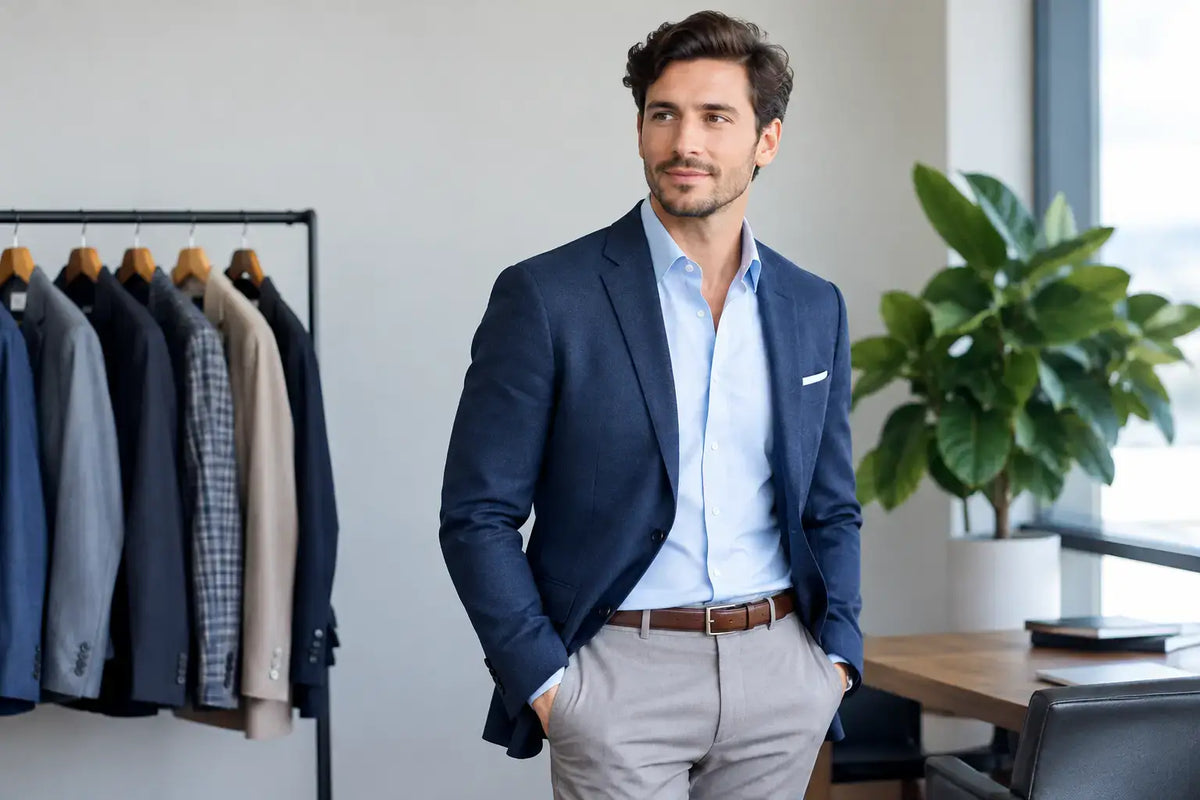
A client presentation and a Friday lunch may both be described as business casual, but they call for different levels of structure. For an important meeting, a navy jacket, pale blue shirt, grey wool trousers and dark brown loafers form a composed, dependable combination. There is no need for a tie, yet the silhouette communicates readiness.
For an informal business lunch, replace the shirt with a fine-knit polo and choose stone or tobacco trousers. The look remains polished, but the softer textures signal openness. For travel, a resilient wool jacket and trousers with a little controlled stretch can preserve shape throughout the day without looking technical or casual.
This is where a private tailoring consultation has value. The right wardrobe is not built from generic rules. It is built around the rooms you enter, the climate you inhabit, your proportions and the impression you intend to make. At DONFIORITO, that conversation informs every decision, from jacket construction to the exact balance of a trouser leg.
The Final Measure Is How You Move
Fine business casual tailoring should never feel like a costume. You should be able to sit through a long meeting, step into a car, greet a client and move through an evening engagement without adjusting your jacket or questioning your appearance. Comfort is not separate from elegance. It is what allows elegance to look natural.
Choose fewer garments, but insist that each earns its place. When the fit is exact, the fabric is appropriate and the proportions reflect your character, business casual stops being a vague dress code. It becomes a quiet expression of standards.

